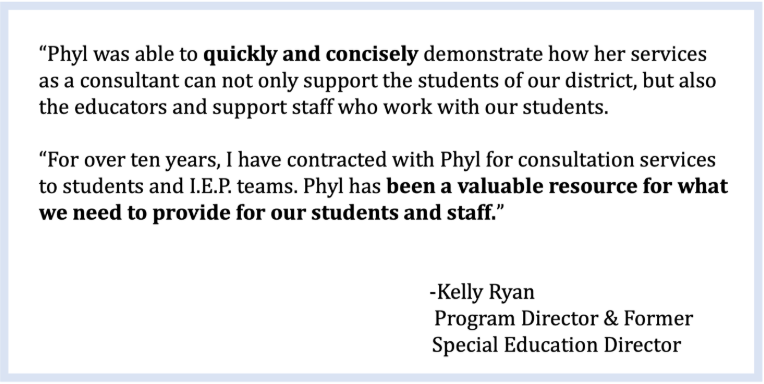

In the classroom setting, special educators must collaborate with general education teachers about inclusive practices to support students with disabilities; yet they may not have the time, intricate knowledgebase, or resources to recommend to teachers how to tailor instruction to each student’s unique needs. In addition, classroom teachers may struggle to balance the requirements of a student’s I.E.P. with the practical realities of the classroom.
Special educators are also responsible for supporting and supervising the instructional support staff who work with these students in a one-on-one or classroom-support model. Paraprofessionals need consistent guidance, training, and strategies at their fingertips to use throughout the day. Due to demanding workloads, special education teachers struggle with having the time to do this properly.
On top of all of this, good communication and collaboration with families of children with disabilities is essential. Special education staff often encounter challenges in engaging with parents, particularly those who have a limited understanding of the special education process or face language barriers.
These challenges can lead to burnout, increased stress, and difficulty in providing the individualized support that students with disabilities require.
Student-specific consultation in special education by a specialist is crucial for creating individual learning experiences that address the unique needs of each student.
It involves collaborating with educators, interventionists, and families to tailor teaching methods and shape the necessary accommodations for a student – ultimately fostering significant academic, social, and emotional growth. When done thoroughly and methodically, it ensures that the student will thrive in all educational environments.

Phyl Macomber’s student-specific consultation model is internationally recognized and is rooted in the belief system that each student has a unique learning style.
As a world-renowned education specialist, Phyl definitively gets the student’s team on the same page with a “one-size-does-not-fit-all” roadmap by providing the educational team with:
- Customized Differentiated Instructional Strategies
- A Toolkit of Evidenced-Based Student Engagement Approaches
- A Social Emotional Learning Student Profile
- Research-Based “Use-the-Next-Day” UDL Teaching Strategies
- Integration of Assistive Technology Solutions
- An Executive Functioning Student Profile Summary
- Detailed goals and objectives for the I.E.P.
This student-specific roadmap bridges the gap between special education and general education. This collaboration is not just a professional necessity, but a moral imperative for creating equitable and effective learning experiences for every student.
As part of her consensus collaboration consultation model, Phyl not only works with educators, but also the instructional support staff. Phyl believes that modeling for paraprofessionals is crucial when providing instructional support to students in accessing the curriculum and participating fully in class. When the instructional support staff are trained, they can better reinforce lessons, clarify concepts, and provide individualized assistance, leading to increased student engagement and academic success.
In addition, Phyl delivers a resource bank of parent collaboration and communication tips to teams, which create a supportive and effective partnership with parents and families. This is vital in the educational process when creating a successful learning environment for students with disabilities.
Open communication between parents and educators ensures that everyone is on the same page and working towards the same goals, leading to a more positive and supportive learning experience. Using Phyl’s proven collaboration model, parents and teachers build trust. This results in students showing improved academic performance, better behavior, and increase engagement in learning.
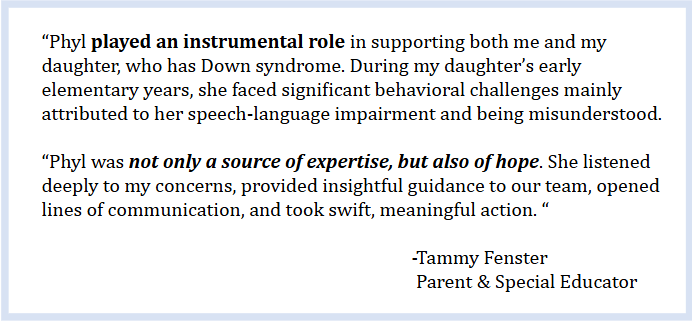

Under her expert guidance, Phyl helps educators – both in general education and special education – build a “teaching toolbox” of differentiated instructional strategies, acknowledging that all students learn differently.
Phyl’s tailor-made teaching methods improve the academic performance of diverse students. Her customized strategies not only address individual differences in learning styles, readiness levels, and interests, but also foster students to have a deeper understanding of the subject matter.
Phyl provides comprehensive techniques in the four areas of differentiates instruction:
- Content: how to change up what is taught
- Process: how to change up how it is taught
- Assessment: how to change up how it is assessed
- Learning Environment: how to change up the context of learning
Using Phyl’s personalized differentiated instructional strategies enhances teacher effectiveness. They empower educators to be more responsive to the diverse needs of their students.
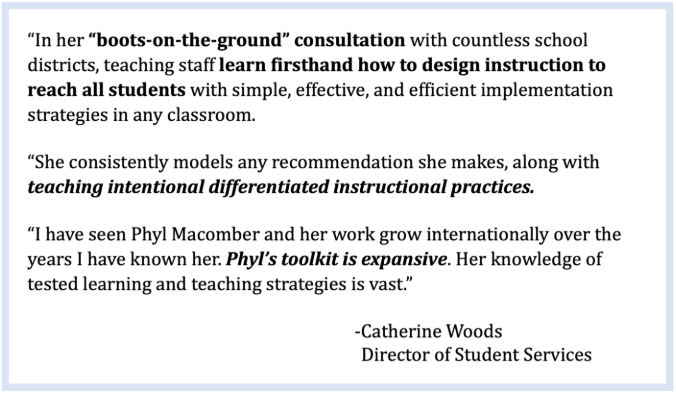
Phyl shows staff how to continually assess student learning and adjust their teaching strategies accordingly, leading to more effective and impactful instruction.
As a result, the students feel valued and respected regardless of their learning style or ability level. These strategies foster a greater sense of belonging for learners and help students feel that their learning is valued.

Educators often question that best ways to encourage participation of specific learners. They sometimes hit a brick wall with getting students they serve to be motivated at any grade level.
Using her evidenced-based student engagement approaches, Phyl trains and supports teams in how information is presented, how students respond in their learning activities, and how to improve their active engagement.
Classroom teachers, special educators, and instructional support staff work with Phyl to identify barriers that impede the engagement of their students, which prompt a redesign of teaching practices.
When students feel that the learning is relevant to their needs and abilities, they are more likely to be engaged and motivated to learn. Regardless of content area, students themselves reported that these approaches have had a meaningful positive effect in their motivation to participate in classes and resulted in greater self-efficacy skills.
Students significantly increase their active engagement in any learning activity or lesson when they believe in themselves.

Understanding a student’s social-emotional learning (SEL) profile is crucial for educators to foster a supportive and effective learning environment. It allows teachers to tailor their instruction and interventions to meet individual student needs, promoting not only academic success but also healthy social and emotional development.
This understanding helps students build crucial life skills like self-awareness, self-management, social awareness, relationship skills, and responsible decision-making, which are essential for success in school and beyond.
From the lens of serving the whole child, Phyl Macomber does an in-depth look to determine a student’s strengths and areas for growth in SEL by giving the team the student’s Social Emotional Learning Profile Summary.
This customized student profile informs educators how to better personalize learning and support. Phyl advises teachers how to present material, structure lessons, and assess learning so that the student can succeed. She summarizes for educators how to advance the academic achievement of the student by improving focus and engagement, positive classroom behavior, and optimistic academic attitudes.
Phyl supports a student’s team with developing essential life skills, such as navigating social situations, managing emotions, and making responsible decisions. Based on the student’s profile, she clearly outlines strategies that promote mental well-being and teach empathy, responsibility, and perspective–taking.
Phyl’s unique approach of embedding the explicit instruction of key executive functions while teaching social emotional learning skills has been adopted nationwide.
She has trained thousands of educators on how to teach the mind-brain connection so a student understands how their emotions impact their learning, emotional triggers, and management of stress and anxiety.
Phyl Macomber instills that understanding a student’s profile is not just about academic success; it is about fostering the whole child, promoting healthy development, and preparing them to succeed in life.

Educators need to create learning environments accessible to all students by providing multiple ways for them to (1) access information, (2) engage with the material, and (3) demonstrate their understanding. This means it is necessary for educators to design instruction to accommodate diverse learner needs and minimize barriers to learning.
Using her time-efficient and practical “Use-the-Next-Day” teaching structure, Phyl masterfully models how to promote equitable educational opportunities which ensure that all students have access to the curriculum and can demonstrate their learning in various ways, which reduces barriers for students with disabilities or diverse learning needs.
These UDL teaching strategies are simple and easy to incorporate in everyday lessons in the classroom and specialized instructional settings.
As a result of this work with Phyl, you improve the academic outcomes and have a more equitable and accessible educational environment.

As a nationally certified Assistive Technology Practitioner (ATP) of RESNA – the Rehabilitation Engineering and Assistive Technology Society of North America, Phyl Macomber is dedicated to promoting the independence and well-being of children with disabilities through increasing access to technology solutions.
Phyl expertly identifies assistive technology (AT) for a student from a range of tools and support applications that are designed to support reading, writing, and language processing capabilities.
She recommends assistive technology based on a student’s specific support requirements. Phyl explains that too much support, or even too little, can lead to significant frustration.
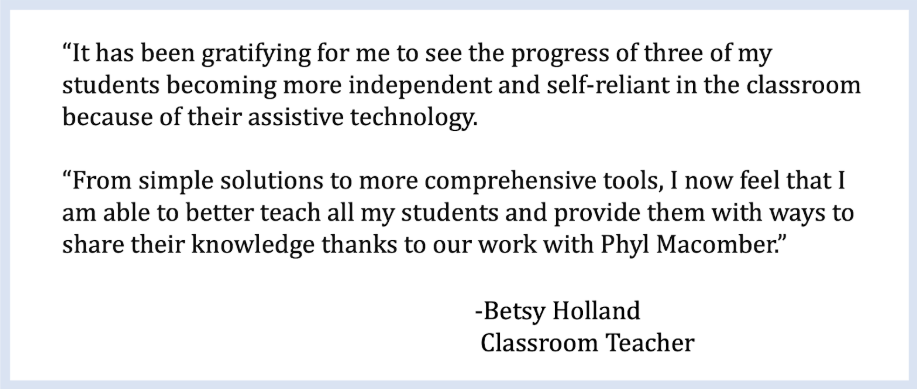
In addition to solving learning obstacles and completing tasks more independently, Phyl incorporates other assistive technology such as AAC devices, which facilitate expression and interaction with peers and educators for students who have communication challenges.
Phyl completed a fellowship at Johns Hopkins Hospital’s Kennedy Krieger Institute in 1988 where she served as their AAC Specialist for international referrals for children with communication difficulties.
Based on her decades of experience, Phyl believes it is best if assistive technology supports are delivered in a “suite” of solutions that can be integrated with specific instructional strategies and connects-the-dots from one brain-based task to the next.
Phyl’s skill of developing a customized Assistive Technology Integration Plan with a student’s team has become widely popular, as it sets up the learning and implementation of the AT in bite-sized chunks.
In this way, the team decreases their anxiety and is not overwhelmed with the learning curve of any of the AT tools. The outcome is that the team has a plan of accountability for each step of the process.

Knowing a student’s executive functioning profile is incredibly important for fostering both their academic and social success. It impacts every aspect of a student’s learning and development. Executive functions are vital cognitive skills necessary for planning, focusing attention, remembering instructions, and juggling multiple tasks effectively.
Phyl shows that by understanding a student’s strengths and weaknesses in the area of executive functions, educators and parents can provide not only the necessary support and interventions, but more importantly, the crucial instruction to build these essential brain-based skills.
Executive functioning skills are essential for students to become learners who are strategic and goal-directed. This is achievable for learners of any ability, including those with special needs and specific learning disabilities, if step-by-step lessons are a part of everyday instruction.
Phyl provides the educational team tremendous insight into a student’s key cognitive processes by completing a detailed Executive Functioning Profile Summary. These include a thorough examination of the following executive functions:
- Organization
- Planning and Prioritizing
- Working Memory
- Task Initiation and Task Monitoring
- Impulse Control
- Flexible Thinking
- Emotional Regulation
- Self-Monitoring
Executive functioning difficulty stems from the inability to regulate or manage one or more of these cognitive processes. This can affect a student’s independence, self-motivation, resilience, social interactions, and academic performance. Giving a student a checklist, timer, or visual directions is not the starting place for executive functioning intervention.
In order to help a student who has executive functioning challenges or weaknesses, Phyl guides the student’s team on how to explicitly teach the learner these skills based on their unique executive functioning profile.

I.E.P. goals and objectives are one of the foundations of special education. They guide instruction for students with disabilities and need to be clear and concise.
Teams, however, battle with the “out of control lengthy I.E.P.” that is often unrealistic to implement in any given school day. Special educators and case managers ask for real help when trying to write a succinct, yet comprehensive, educational plan for a student.
Classroom teachers need assistance with incorporating these student-specific objectives and accommodations into everyday instruction. It is not that they do not “want” to do it, rather they need help in “how” to do it.
Many parents report that they often do not understand “what” their child is working on and “why” because the learning targets are not written in concrete language. In many instances, they do not feel a part of the process of developing their child’s individualized education plan.
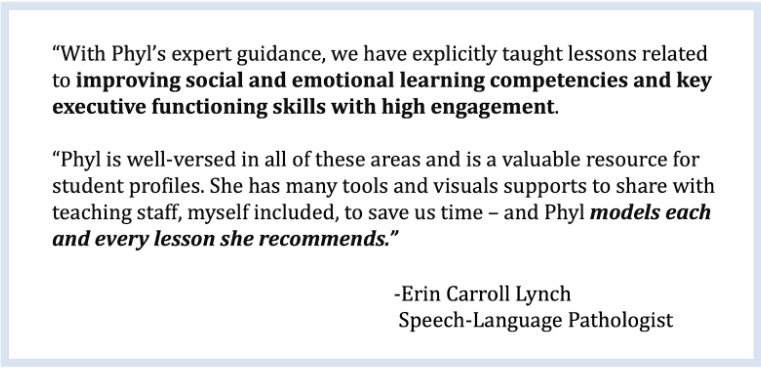
When consulting with Phyl Macomber, a student’s educational team works together under her leadership to develop a “reasonable-in-length” I.E.P. and practical plan of action.
Phyl guides the team in identifying customized, well-structured, and effective goals tailored to the student’s unique strengths and weaknesses. These goals and objectives detail what the student will achieve with specificity using easy-to-understand language. They reflect how progress is measured and when it will be achieved in a realistic timeframe.
In addition, Phyl leads teams in how to mold accommodations for a student’s I.E.P. to a specific task. These accommodations are specific to the learning activity or assessment, ensuring they directly support the student’s ability to participate and demonstrate their knowledge.
These accommodations are not “copy-and-paste-one-size-fits-all” accommodations. They are directly aligned to the needs of the particular student and their I.E.P. goals and objectives. Phyl is a “master” at teaching how to incorporate accommodations into lesson plans and intentional instruction.
These custom-made accommodations empower students with disabilities to:
- access the curriculum
- participate fully in the learning environment
- achieve their academic goals
For students with disabilities, complex skills can be overwhelming for I.E.P. teams to break down into small, manageable steps. With Phyl’s skillful facilitation, there is enhanced teamwork and true collaboration amongst all educational team members – classroom teachers, special education staff, therapists, interventionists, administrators, and families – when developing meaningful goals and objectives in the student’s individualized education plan.