Every Child Can Learn:
Your Roadmap to Inclusive Education
Every Child Can Learn: Your Roadmap to Inclusive Education, is a research-based “How-To” guide for teaching students of all abilities – from gifted to special needs. It has been referred to as “common sense education” by educators from around the globe.

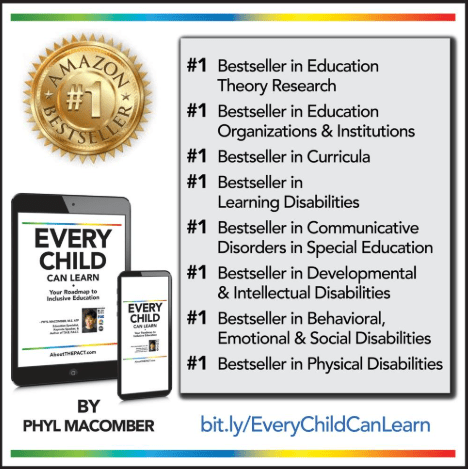
This must-read book hit the Amazon #1 bestseller list in the first 24 hours of release in eight educational categories:
- Bestseller in Education Theory Research
- Bestseller in Education Organizations and Institutions
- Bestseller in Curricula
- Bestseller in Learning Disabilities
- Bestseller in Communication Disorders in Special Education
- Bestseller in Developmental and Intellectual Disabilities
- Bestseller in Behavioral, Emotional, and Social Disabilities
- Bestseller in Physical Disabilities
Every Child Can Learn provides a blueprint of practical “use-the-next-day” Universal Design for Learning strategies to solve everyday problems in education for differentiated instruction and meaningful inclusion.
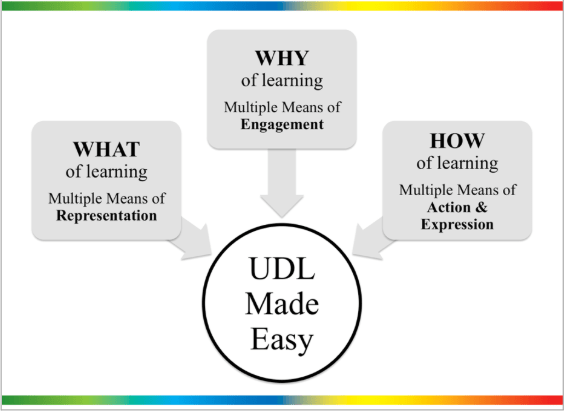
The book’s 4-step, easy to use teaching roadmap has been internationally proven to successfully bridge the gap between special education and general education.
The strategies in Every Child Can Learn solve the pressing problem of how to balance developing creative lessons to reach all learners and using planning time wisely: working smarter, not harder.
Your Roadmap to Inclusive Education
International education specialist and author, Phyl Macomber, outlines lesson after lesson, from preschool to high school, across a wide cross-section of subject areas so that teachers can easily replicate the teaching in classrooms with anyone of any ability.
In addition to viewing connect-the-dots lessons for academics, Every Child Can Learn also provides step-by-step examples of how to use these strategies in special education and therapy services, along with teaching a growth mindset, building leadership skills, setting up summer services, and implementation in homeschooling for families.
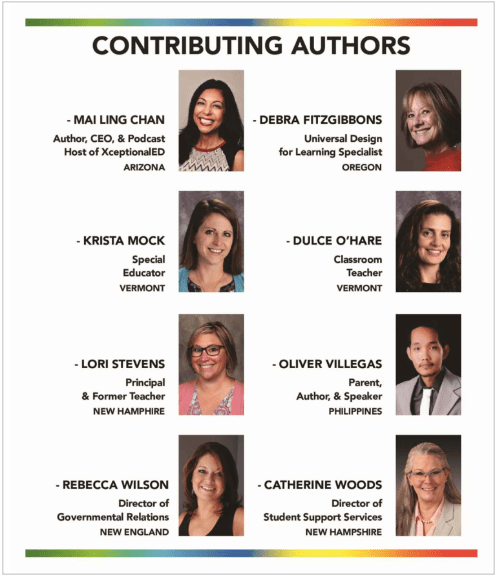
Every Child Can Learn has eight contributing authors from unique areas around the world. Their wisdom provides meaningful insights into shaping the education of our youth based on their own unique area of expertise.
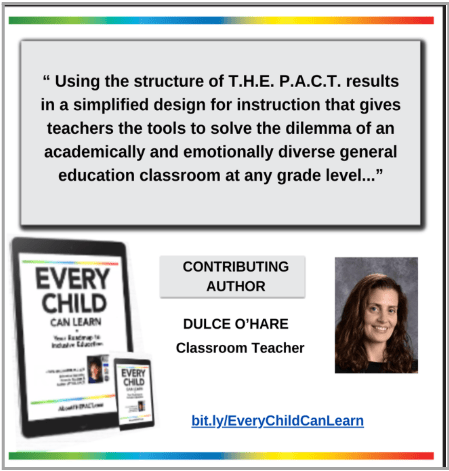
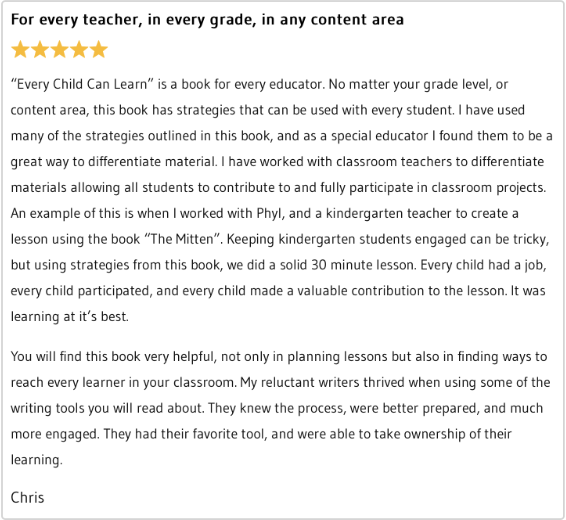
The immediate result is simplifying learning, which in turn, simplifies teaching.
Any grade, any content area, any learner.
Price: $49.99
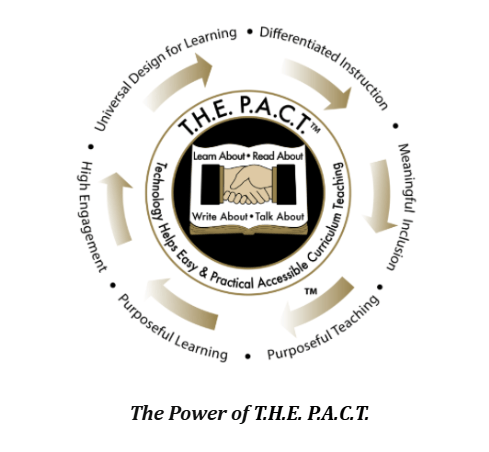
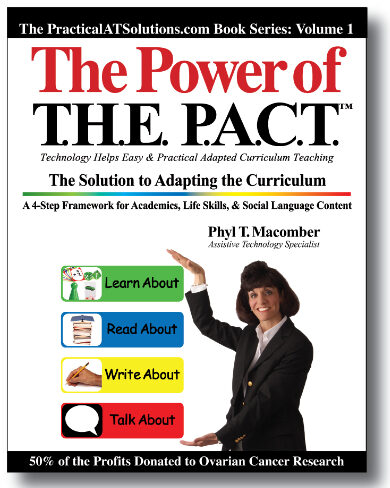
The Power of T.H.E. P.A.C.T.
Serving as an International Education Specialist working in the “trenches” in both educational and vocational settings, I have identified a problem that I see many teams continually struggling with – finding the time to adapt lessons and customize overall curriculum content and learning formats for individuals receiving special education services or vocational rehabilitation services.
Providing curriculum support – whether academic or under the life skills umbrella – to individuals that are special learners in a classroom environment, work setting, community, or group home can be very challenging.
In the field of education, inclusion requires us to look at the specifics of how these students can best learn in a least restrictive environment. Once leaving the educational system, these individuals continue on a life-long learning process to improve their level of independence related to domestic living skills, vocational training, leisure and recreation interests, and accessing their community.
Teams serving these populations realize that “one size does not fit all” when it comes to adapting curriculum for these learners. This individualized type of customization for a learner takes time when looking at how to adapt content of what is being taught in the instructional setting.
Oftentimes, we then add assistive technology supports to the equation – technology that is supposed to make our jobs easier and, most importantly, help the individuals become more independent – and the outcome of all of this, is a feeling of frequently being overwhelmed.
The easy solution to these problems is that when new content needs to be adapted for a learner, the team does not have to start from scratch.
They will no longer need to play “catch up” with the ever-changing curriculum, frequently asking themselves, “How will I present this information to the student in a meaningful way?” or, “Which support would be best for this part of the lesson for this young adult?!”
Instead, the team follows and implements a carefully planned and customized teaching method for the learner using the research-based teaching framework that I authored called T.H.E. P.A.C.T. framework.
The Power of T.H.E. P.A.C.T., is a research-based roadmap for teaching anything to any learner of any ability or any age. This pre-K through graduation instructional framework outlines how to simplify teaching, which in turn simplifies learning.
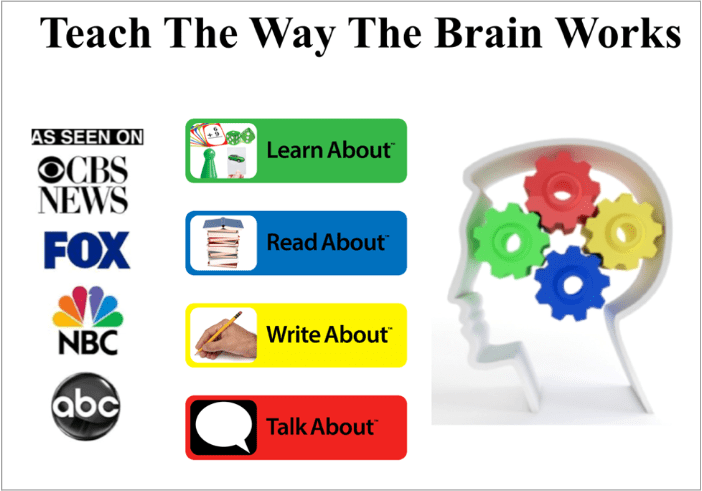
T.H.E. P.A.C.T., which stands for Technology Helps Easy & Practical Accessible Curriculum Teaching, consists of four easy-to-design-and-use modules titled Learn About, Read About, Write About, and Talk About – each aligned to educational standards.
This language-based framework, as explained in detail in the book, The Power of T.H.E. P.A.C.T., is a blueprint for Universal Design for Learning and differentiated instruction. This easy-to-implement teaching approach solves the problem of having to reinvent the wheel to meet each student’s customized needs in any classroom.
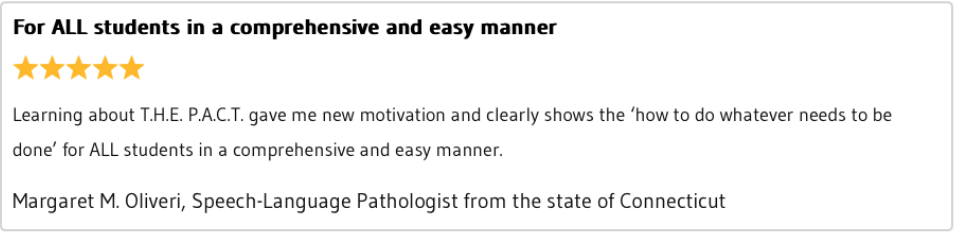
T.H.E. P.A.C.T.’s system of teaching provides “connect-the-dots” instruction, so that both students and teachers understand WHAT they are doing and WHY. Regardless of subject or topic of study, teachers methodically walk students through “learning about” it, “reading about” it, “writing about” it, and “talking about” it.
By adding structure, predictability, and consistency to the learning process, which are all bedrock principles of T.H.E. P.A.C.T., it significantly decreases cognitive load for students of all abilities. Additionally, students understand the relevance of what they are learning.
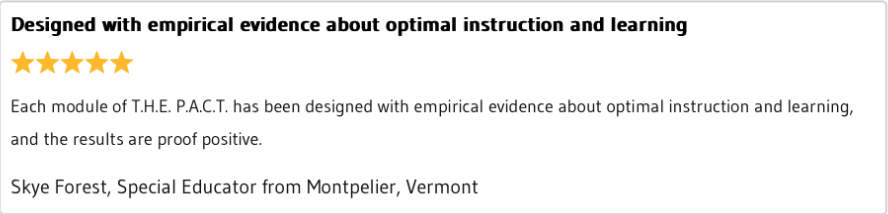
The Power of T.H.E. P.A.C.T. outlines detailed case studies of diverse learners and teams who have experienced the benefits of using this instructional delivery solution for academics, life skills, and social language content – resulting in high-quality instruction and high engagement in students with varying disabilities.
The book has organized charts and tables for “At-A-Glance” essential content related to implementing the framework that you can “use the next day.”
I will tell you that I solve problems for a living. And, oftentimes, it is not an easy fix. Each individual with a disability is like a unique puzzle. You have to methodically go through the process, build a solid frame, and then fill in the holes with all the proper interlocking pieces that fit just right.
When I was a child and went to my parents for advice, my Dad would always say, “You can come to me and Mommy with any problem. But we are only going to talk about that problem for a part of the time – five or ten minutes. The rest of the time, we’re going to focus on solutions. That is how you get though life, honey.”
When you use T.H.E. P.A.C.T. framework, you will see that you are focusing on a practical solution to any instruction.
Author Brian Tracy once made a statement that really gets at the heart of what T.H.E. P.A.C.T. does for those who use it. He said:
“There is never enough time to do everything,
but there is always enough time to do the most important thing.”
We all know that there are more things to be done in any given day than most of us can realistically do. The central issue is identifying those things that are truly essential if meaningful results are going to be achieved.
T.H.E. P.A.C.T. helps teams make certain that the most important things do get done.