October 2017 – International Journal of Research & Reviews in Education
Impact of two different infographics types “interactive-
static” on developing mathematical
concepts among female students at second grade intermediate in the
Kingdom of Saudi Arabia
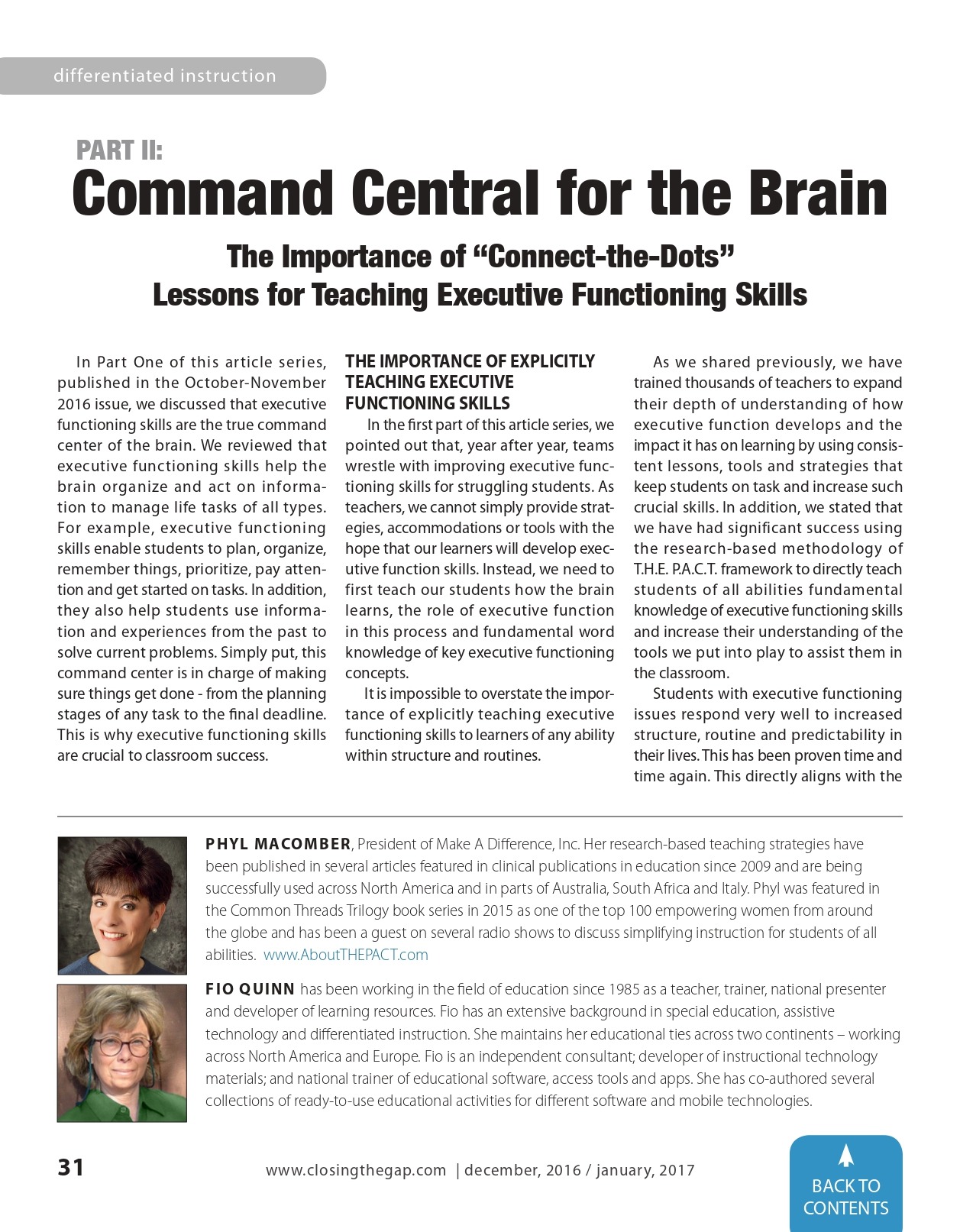
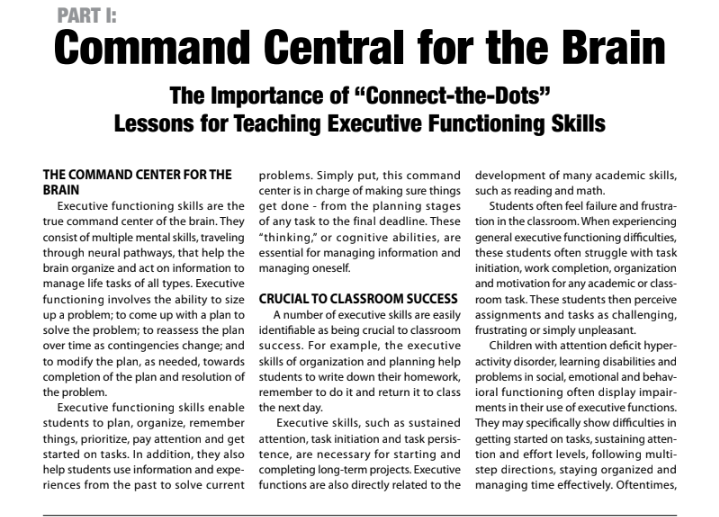
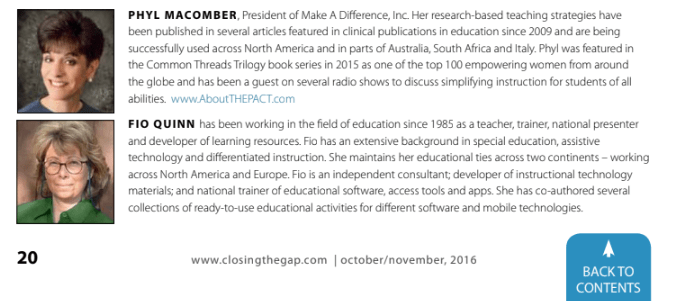
October/November 2016 – Closing the Gap Solutions Part 1
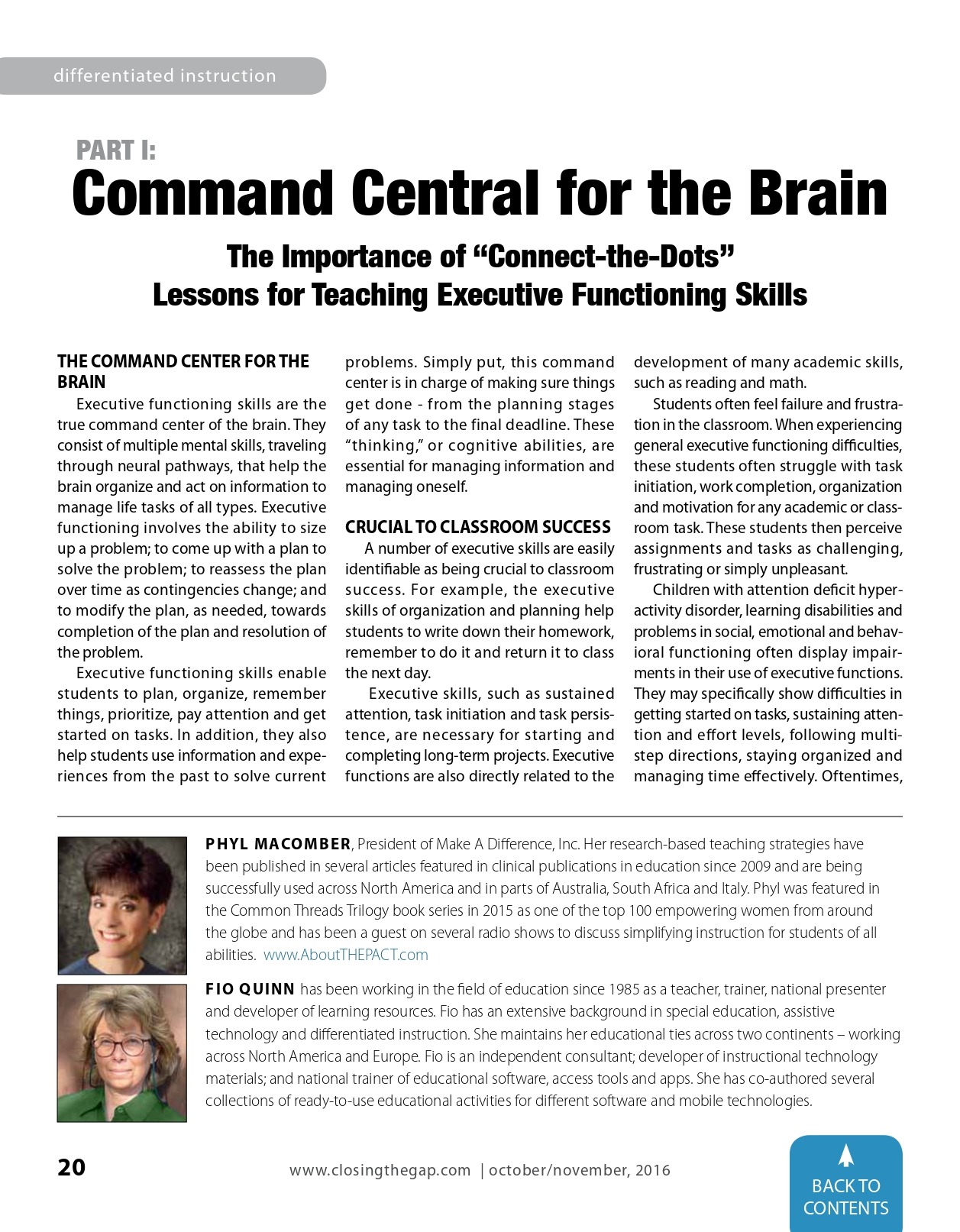
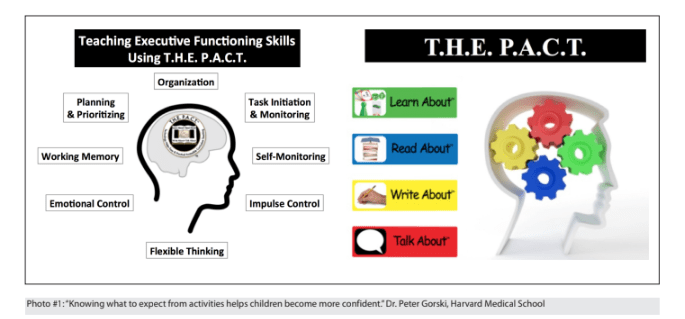
Command Central for the Brain
The Importance of “Connect-the-Dots”
Lessons for Teaching Executive Functioning Skills
December/January 2016 – Closing the Gap Solutions Part 2
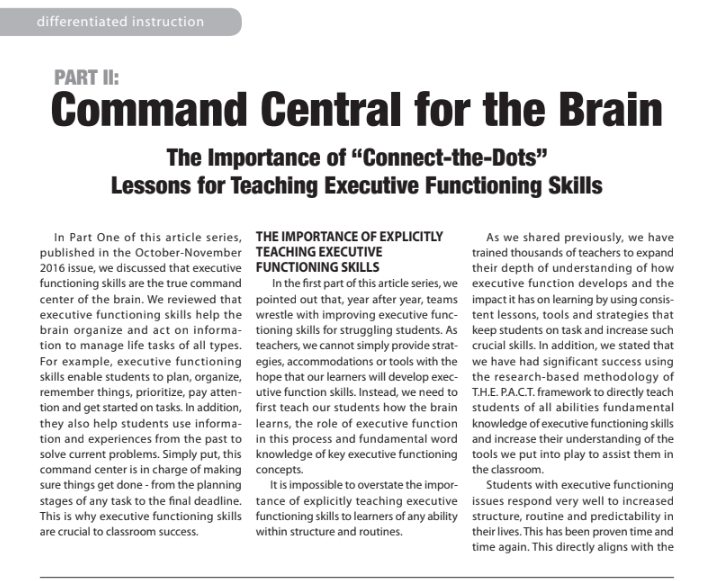
Command Central for the Brain
The Importance of “Connect-the-Dots”
Lessons for Teaching Executive Functioning Skills
June/July 2014 – Closing the Gap Solutions
Bridging the Gap Between General Education and Special Education:
The ImPACT of Universal Design for Learning
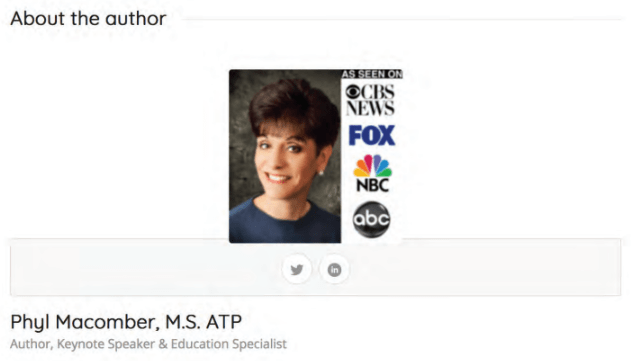
Phyl Macomber is the CEO of Make a Difference Inc. She is an award-winning speaker, bestselling author, and education specialist who has trained thousands of educators around the globe, advocating for children of all abilities to reach their potential in an inclusive environment. Phyl’s Amazon #1 bestseller Every Child Can Learn: Your Roadmap to Inclusive Education is being referred to as “common sense education” by educators around the world.
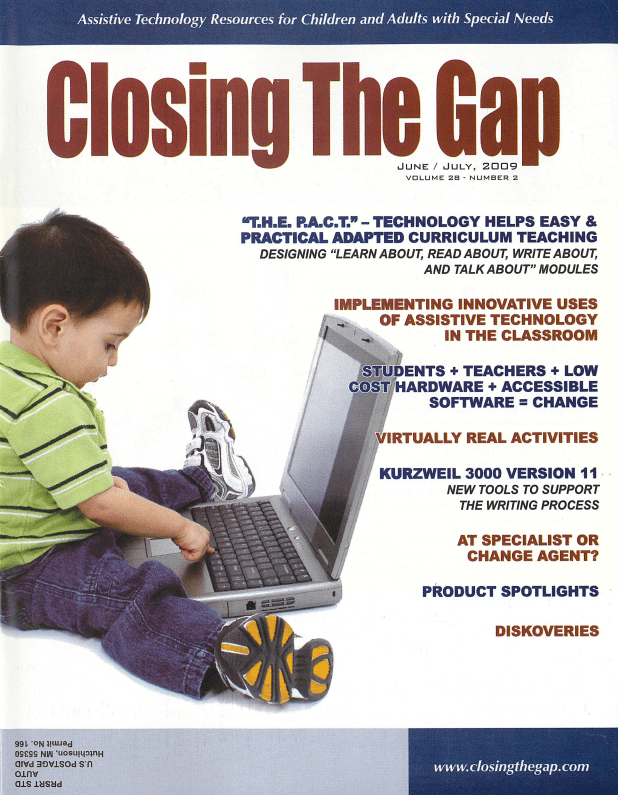
June/July 2009 – Closing The Gap
T.H.E. P.A.C.T. – Technology Helps Easy & Practical Adapted Curriculum Teaching
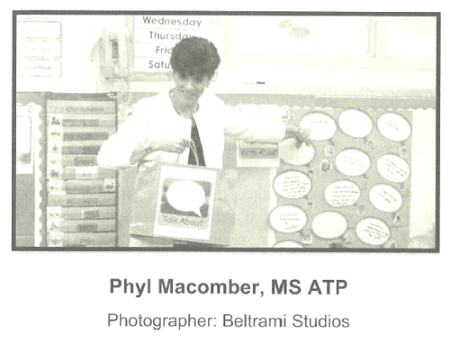
Designing “Learn About, Read About, Write About, and Talk About Modules”
Click here to read the text version of the Additional Publications
How do we get children eager to read? Phyl, Krista and Kathryn discuss how ‘student buy-in’ and interaction plays a big part.
As teachers, we often struggle with how to get our students excited and engaged in language arts. We frequently run out of ideas about how to give students background information and context of a book, or a chapter, in creative and interactive ways. We also need to help our students build essential comprehension that is sometimes lost, when decoding takes the front seat while reading.
We have some strategies to share that could jumpstart your literacy instruction and get students more involved and motivated to read!
We find that when students participate in the creation of their literacy tools, we get more “student buy- in” and the important information from the text that we want to impart to our learners better resonates and sticks in their brain.
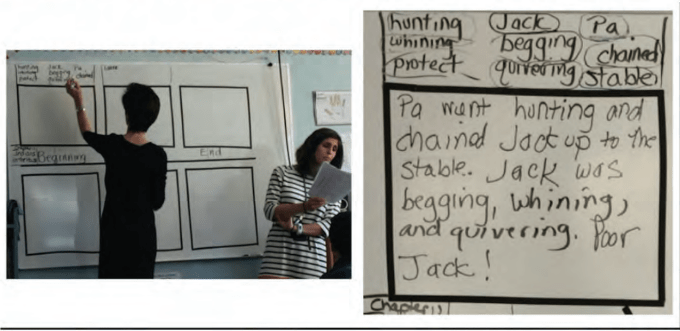
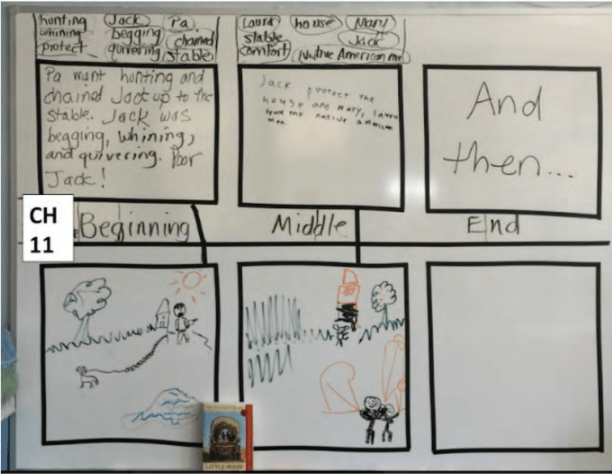
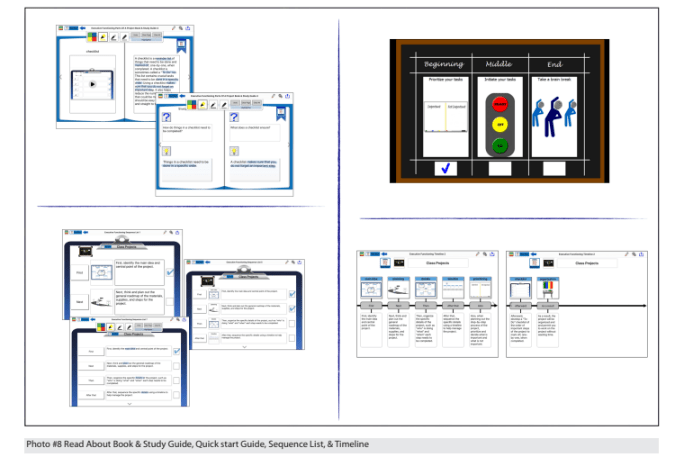
This strategy is using “build-your-own” timelines for chapter previews. It involves building sequence- based information related to events of the chapter, BEFORE the students read the chapter – organized in “BEGINNING, MIDDLE, and END” components.
We find that when students participate in the creation of their literacy tools, we get more “student buy- in” and the important information from the text that we want to impart to our learners better resonates and sticks in their brain.
This strategy is using “build-your-own” timelines for chapter previews. It involves building sequence- based information related to events of the chapter, BEFORE the students read the chapter – organized in “BEGINNING, MIDDLE, and END” components.
Chapter previews give all students “Coming Attractions” to build an understanding of connections and a linkage of ideas for a chapter. We model how to create a word bank from listening to an oral summary of each part of the timeline and then demonstrate how to rewrite the summary points in your own words – a crucial skill for students in the writing process to become meaningful authors. Illustration and acting out of the “Coming Attractions” also provide a necessary kinesthetic learning approach that meets the needs of all students. So, here are some ideas to add to your “Language Arts Toolbox!”
Creating a Vocabulary Table
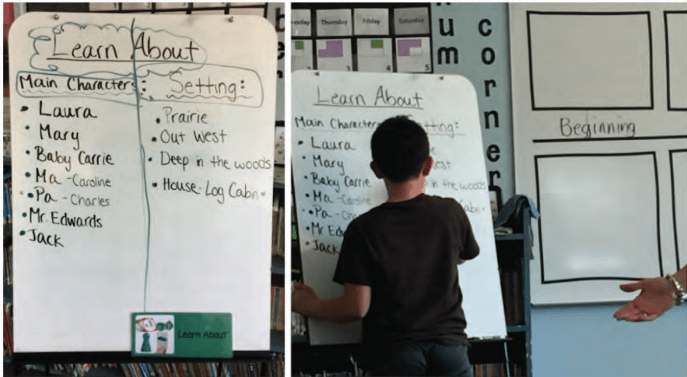
As a first step, create a Vocabulary Table with your students to put the story elements in the forefront of your students’ minds. This visual support provides an interactive review of key word meanings in the book; along with a preview of terms related to the upcoming chapter they are going to read. In this example, the students are already thinking about the characters and settings pertaining to the upcoming chapter of the book and are also placing their prior knowledge of the previous chapters at their fingertips to reference throughout the language arts lesson. Most importantly, creating a Vocabulary Table at the start of a literacy lesson decreases the cognitive load of the students by providing a visual tool to continually reference, assuring that all students have a better understanding of the key vocabulary terms that are embedded within the text they are about to read.
Listen, List, & Summarize: The Importance of a Chapter Preview Word Bank
After creating the Vocabulary Table, the teacher then orally summarizes the “beginning” and “middle” of the chapter for the students – leaving the “end” as a cliffhanger for them to find out what happens when they read the chapter. During this time, a Chapter Preview Word Bank is created by writing down the key vocabulary words from the teacher’s oral summary on the white board. Pointing out and scribing vocabulary words from the oral summary gives students an opportunity to hear key vocabulary words before trying to read them and instructs students on how to create their own table for note-taking in the
future.
This prior exposure to vocabulary words, as well as a discussion of their meanings, allows students to build understanding of the key concepts and improves comprehension once they locate and read these terms in the foundation of the text. Next, a sentence is written, using the Chapter Preview Word Bank as a guide, to summarize the segment of the timeline related of the chapter. The sequence of these steps – listening to an oral summary, noting down key vocabulary to develop a word bank, and composing a summary sentence – is a critical instructional strategy to give students repeated opportunities to preview vocabulary and get “Coming Attractions” for the most important events which occur in the chapter.
Working Together on Illustration Teams
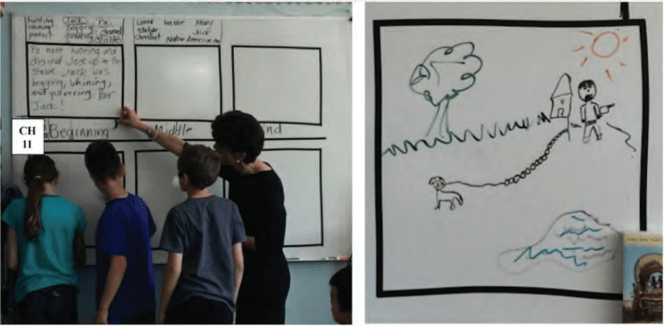
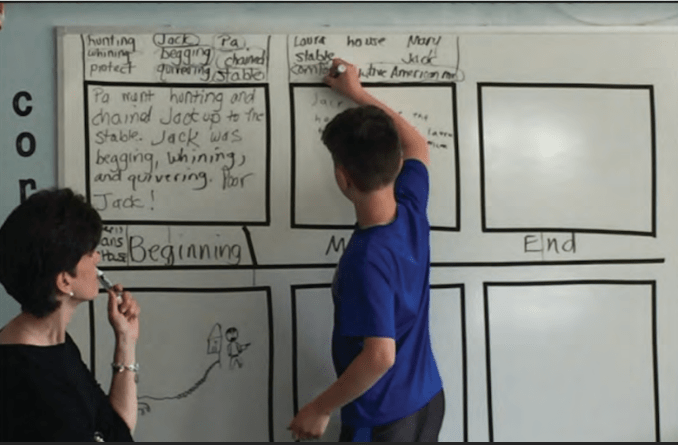
Next, illustration teams of students are formed to expand their understanding of the summary point by drawing a picture to represent the “beginning” and “middle” summary sentences. This gives the students the opportunity to provide their own unique visual expression in the form of an illustration, along with figuring out how they will work together as a team sharing a workspace. This also teaches students how to create a visual with describing details from the Chapter Preview Word Bank. Being on an illustration team helps learners picture the scene in their mind and connect it to what they will be reading in the upcoming chapter.
Circling Key Concepts in Timeline Summary Points
After that, students identify and circle words from the Chapter Preview Word Bank, which are used to write or compose the summary point. This helps students “laser-focus” on the details in the summary point and, in turn, improves their own writing skills. When students examine a sentence and cross-reference a vocabulary bank that originated from a teacher explanation, it shows them how to compose summary points in their own words. This gives learners additional ideas that they themselves may not have thought of to include, related to key details. Also, this strategy shows students how to circle back around to the key vocabulary that the teacher pointed out in the oral summary of the chapter preview. It significantly helps students build a strong understanding of the main ideas of the specific component of timeline related to the chapter of the book they are going to read.
Increasing Engagement & the Love of Reading
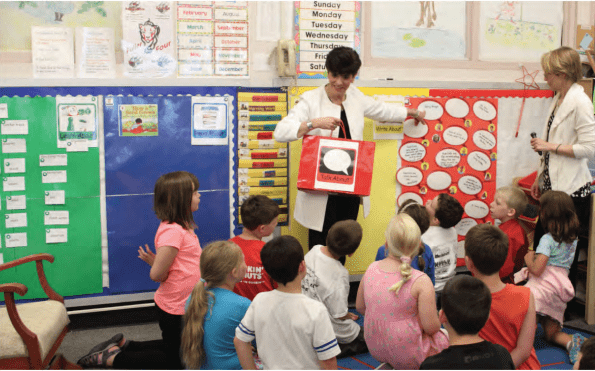
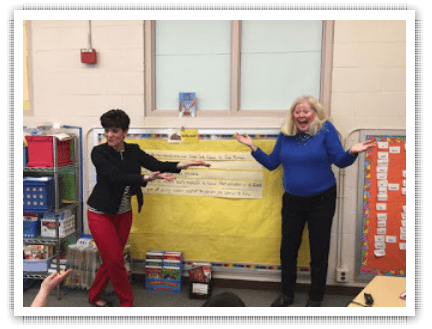
Finally, the students actout the timeline so that the chapter preview “comes to life.” READY, SET, ACTION!
Creating chapter previews with our students of all abilities helps them build meaning and understanding before they even begin to read. Reading fluency is also improved by providing students with chapter previews, as this strategy gives our students prior exposure to content, keywords, and main ideas before they try to simultaneously decode and comprehend unfamiliar literature.
So, remember, chapter previews:
• Give students “coming attractions” to better improve cognitive focus
• Engage students in active learning
• Outline key “takeaways” for better retention
• Teach students critical skills for the eventual writing process
• Composing
• Summarizing
• Note-taking
• Revising
For more information on these research-based UDL strategies related to this article, please go to AboutTHEPACT.com. Best wishes in making a difference,
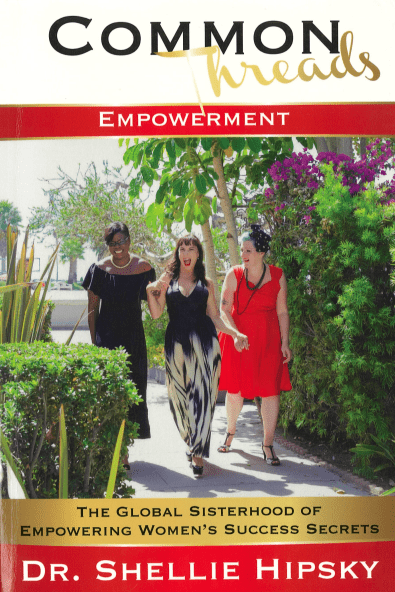
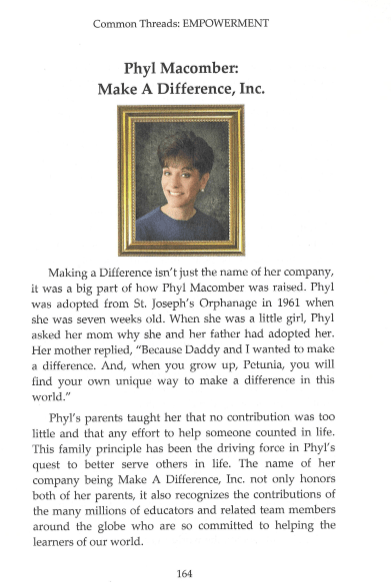
Since completing a fellowship at Johns Hopkins Kennedy-Krieger Institute in 1988, Phyl Macomber has become an award-winning keynote speaker, author, and education specialist. Phyl has consulted with and trained thousands of teaching staff and was featured in the international best seller, the Common
Threads Trilogy book series, as one of the top 100 empowering women who is a passionate catalyst for systems change in education.
Phyl has been a guest on numerous radio shows to discuss simplifying instruction for students of all abilities. Phyl serves two ambassadorships – the first for the educational affairs organization, I AM Living Education Everyday and the second at Energime University, based in Manhattan, as the educational co-producer of the University’s global youth program, Mission Earth Solutions. Her partnership with South Africa-based Leave No Girl Behind International is training young people in key leadership principles globally. Phyl has created a 4-step simple system for how to teach anything to anyone, called T.H.E. P.A.C.T., which is outlined in Phyl’s first book, The Power of T.H.E. P.A.C.T. Her research-based teaching strategies have been published in numerous articles featured in education publications since 2009 and are being successfully used across North America and in parts of Australia, Italy, Saudi Arabia, and Africa.
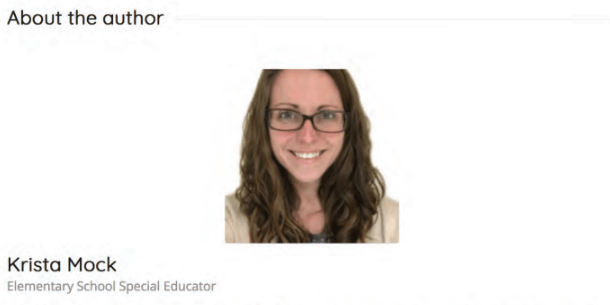
Krista Mock is an elementary school special educator, who serves students with varying abilities and disabilities – including Autism Spectrum Disorder, Intellectual Disabilities, and a range of Learning Disabilities. Krista’s distinct expertise is in supporting classroom teachers in meaningful inclusion of children with disabilities. She spends a significant amount of time each day in the classroom, delivering differentiated instruction in a co-teaching model for math and language arts. Krista has a passion for helping children and families by striving for collaboration and cooperation amongst general education and special education. She firmly believes in the power of teamwork and improving the lives of the students and families that she works with every day.
Krista’s whole-child philosophy of education focuses not only on meeting the academic needs of students, but also on the social-emotional aspects of their education. This is why she began her career in education as a preschool teacher, integrating all aspects of curriculum and developing supports that were customized to meet the needs of each and every child and family she served. This family-centered philosophy is a bedrock practice that she brings to her current position.
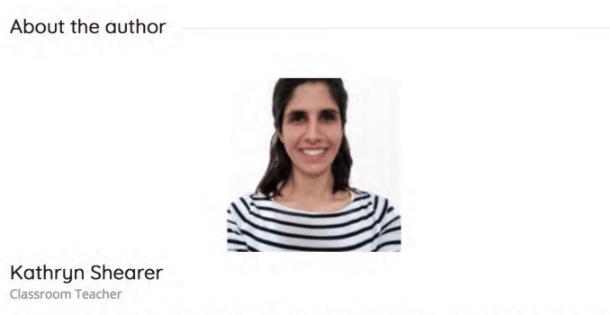
Kathryn Shearer came home from her first day of kindergarten and announced that she would become an elementary school teacher when she grew up and she is happy she took the advice of her kindergarten self. Since 2012, Kathryn has created magic in her classrooms – mastering the art of how to immediately focus and engage students of all abilities, so her students master the art of loving to learn. In addition to serving as a literacy interventionist, Kathryn is currently a classroom teacher on a 3-4-5 multi-age grade team and is a model for other educators of how to provide UDL lessons and differentiated instruction in a co-teaching model with her special educator.
Prior to that, she worked in higher education in a civic engagement office and was the Program Director of the scholarship and mentoring program. Currently, during the summer months, Kathryn is the Program Director of a sleep-away camp for middle-school and high-school aged girls, which focuses on training leadership skills for children in the area of strength – highlighting strength of character in working together, in addition to physical strength in the various outdoor adventure activities offered.
Writing is simply a means for recording information. Who would think that this basic act would be so challenging for students day after day?
TEACHER ACTION: “Today, we’re going to write a persuasive essay.”
STUDENT REACTION: “What does ‘persuasive’ mean?”
TEACHER ACTION: “Let’s grab an iPad from the cart. Today, we are going to start writing our summary of the biographies we read.”
STUDENT REACTION: “Where do I start?”
Oftentimes, writing assignments are given with one basic quick model or demo of what is required – sometimes from a basic template form – and then students are asked to get started independently from there. It is the common scenario of, “On your mark, get set, go!”
And we know how that often turns out. Increased reliance on adult support… Not every student succeeds… Students not really knowing the “roadmap” of their writing task.
To solve these problems, teachers – both in general education and special education – are seeing the value of group writing lessons to explicitly teach each individual steps of the writing assignment, prior to students engaging in breakout, individual writing sessions.
For example, I co-teach group writing lessons on a regular basis in my mentoring and coaching program for educators. Here was the intro dialogue at the start of one of these group writing lessons:
“Today, we are going to do a group writing lesson. We are going to write about one of the biographies that you learned about and read about. It will have 5 parts. The end result will be a paragraph summary. Let’s review what a ‘biography’ is and post on the board a Learn About Tip to define the term ‘biography.”
For students of any ability, we need to separate out formulating thoughts of “what to write” from sequencing and organising them. If all of these tasks are required of students at the same time, the cognitive load is too high. This, in turn, affects not only their desire to engage in writing tasks, but also the ability of the learners to sustain a writing session for a given period of time.
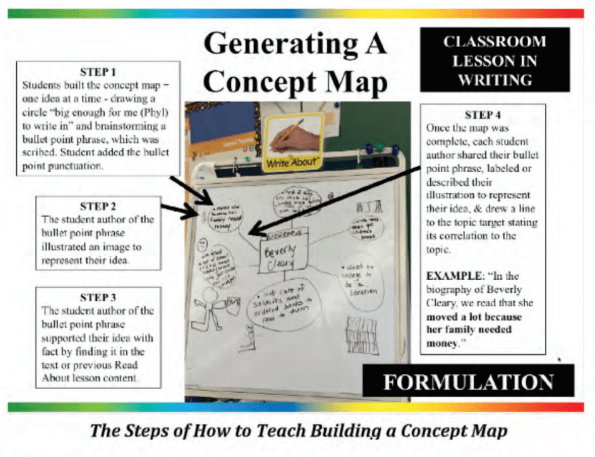
PART 1: Brainstorming a concept map with bullet points on what the students “learned about” & “read about” a biography of Beverly Cleary (an author of children’s and young adult’s fiction).
The students did the following:
• Formulate a bullet point about the topic
• Draw a circle in which to place their thought .
• Add the bullet circle at the start of the phrase
• Illustrate an image to represent their thought
• Support the idea with a fact from the text
• Draw a line to the main idea once the bullet point was entered
PART 2: The class developed a list of words to use as referents for the main idea – in this case, the character, Beverly Cleary – to avoid the overuse of the character’s name in each sentence.
Examples the students formulated were:
• This young girl
• This child
• This author
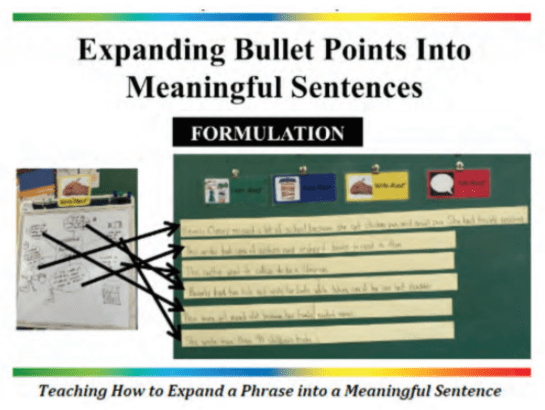
These words were sentence-starter options for students to use to expand each bullet point into a meaningful sentence.
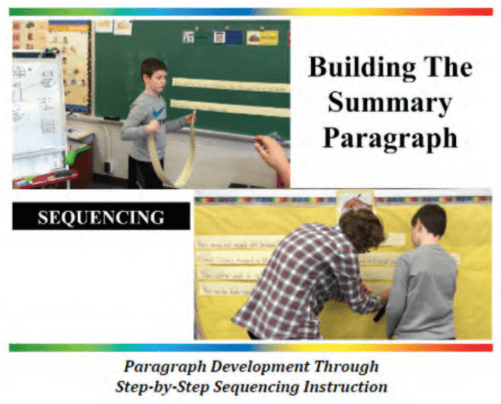
PART 3: The sentences were generated one at a time by the students – in NO PARTICULAR
ORDER – from the bullet points on the Write About Concept Map using the referent words. The sentences were scribed onto yellow sentence strips. As each sentence was formulated, it was place on the board.
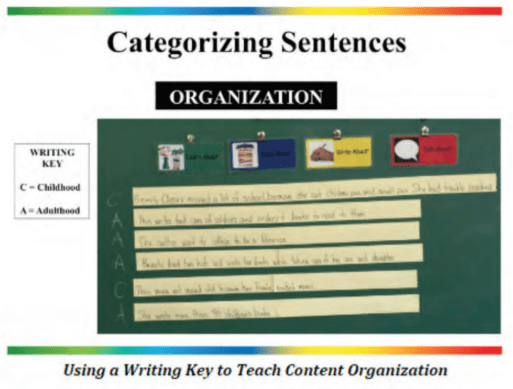
PART 4: Now that students have formulated their sentences from their bullet points, it was time to organise the sentences: those sentences that were about Beverly Cleary when she was a child – by marking the letter “C” next to the sentence – and those that represented her life as an adult, marked with the letter “A.”
In addition, the students numbered the sentences in sequence, as they wanted them to appear in their paragraph – first from the “child” category and next from the “adult” category.
PART 5: After that, the students physically placed the sentences they wrote for the biography summary on the Write About classroom board to organise and build – literally – the paragraph.
EACH student was engaged in this 45-minute writing lesson. EVERY student participated.
Students were now better prepared for their breakout writing sessions on different biographies that they would select using the strategies we taught them to breakdown their writing assignments.
And, by the way, this lesson format can be used over and over again in group writing lessons so that it is consistent and predictable for the learners – regardless of what they are writing about.
SUCCESS FOR ALL!
For more information on these research-based UDL strategies related to this information, please go to AboutTHEPACT.com.
Warmest of regards,
Since completing a fellowship at Johns Hopkins Kennedy-Krieger Institute in 1988, Phyl Macomber has become an award-winning keynote speaker, author, and education specialist. Phyl has consulted with and trained thousands of teaching staff and was featured in the international best seller, the Common Threads Trilogy book series, as one of the top 100 empowering women who is a passionate catalyst for systems change in education.
Phyl has been a guest on numerous radio shows to discuss simplifying instruction for students of all abilities. Phyl serves two ambassadorships – the first for the educational affairs organization, I AM Living Education Everyday and the second at Energime University, based in Manhattan, as the educational co-producer of the University’s global youth program, Mission Earth Solutions. Her partnership with South Africa-based Leave No Girl Behind International is training young people in key leadership principles globally.
Phyl has created a 4-step simple system for how to teach anything to anyone, called T.H.E. P.A.C.T., which is outlined in Phyl’s first book, The Power of T.H.E. P.A.C.T. Her research-based teaching strategies have been published in numerous articles featured in education publications since 2009 and are being successfully used across North America and in parts of Australia, Italy, Saudi Arabia, and Africa.
Global Efforts to Build Leadership Skills in K- 12 Education
Since completing my fellowship at Johns Hopkins Kennedy-Krieger Institute in 1988, I have trained thousands of teaching staff across North America and in parts of Australia, Italy, Saudi Arabia, and Africa. Unfortunately, many of the same problems that existed back then in education continue to persist today, regardless of the calendar year or the postal code of the location.
The fundamental fact is that our educational systems have become extremely complicated, regardless of where you live in the world. Each day, we walk into our schools, go inside our classrooms, arrive at our learning centers, or enter our therapy settings… and face trying to simply keep our heads above water.
We all attempt to cover an incredible amount of information in an unrealistic, often impossible, limited amount of time. Instruction in today’s educational system is typically delivered in days filled with multiple things to do and just not enough time in which to do them – with people often feeling very under-appreciated. Because of these challenges, we are frequently forced to take a reactive approach to instruction, rather than a proactive one, often not even knowing what the other person is doing due to decreased collaboration time.
I can attest to this because I spend a great deal of time in schools as the author and creator of the research-based teaching framework called T.H.E. P.A.C.T. I mentor, coach, and train educators – both in general education and special education, showing them how to deal more effectively with these very problems and how to consistently get more results from their time and increased engagement from their students.
Differentiating Instruction & UDL
The solution is quite simple: as educators, we need teach in the way that our brain works… in a sequence or order that makes sense to students, teachers, and parents.
It is also important to remember that good content does not always equal sound instruction. A
vast amount of curriculum content is not delivered in “bite-sized” chunks in the classroom – nor
in a brain-based sequence – that best fosters understanding and demonstration of knowledge that our students need, regardless of their ability, in order to meet the standards.
Due to challenging time constraints and unrealistic pacing guides, curriculum instruction is often like getting on an “elevator” – one day going to the 24th floor, and the next day back down to the 4th floor, and the following day, shooting up to the 60th floor, with instructional lessons not linking with each other. Students of all abilities often struggle to know the “WHAT, WHY, and
HOW” of their instruction and how one lesson relates to the next.
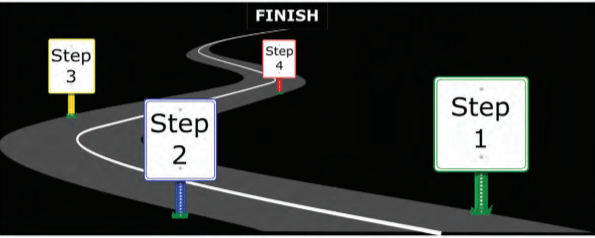
The answer is to deliver instruction in a “connect-the-dots” teaching and learning approach: methodically taking the stairs, instead of the elevator, sequentially achieving one step of mastery at a time – drawing a line from one lesson to the next – to significantly improve overall academic performance and increase meaningful participation. It is critical that educators have a systematic roadmap that is easy to follow for teaching anything to anyone at any grade level. This roadmap needs to have “no expiration date,” so to speak; meaning that it could be used from preschool to high school. In addition, it is crucial that this curriculum solution work with students of ANY ability, from gifted to special needs – and every learner in between, to bridge the gap between special education and general education and foster meaningful inclusion of students with disabilities using inclusive strategies.
Simplify Learning & Simplify Teaching
We need to simplify the process of learning, which in turn, simplifies teaching for teachers. T.H.E. P.A.C.T. methodology is a simple, research-based template system for learning and is of zero cost to implement since it is a conceptual framework. This delivery system of instruction is four basic steps – which means that it is easy to implement in a jam-packed school day.
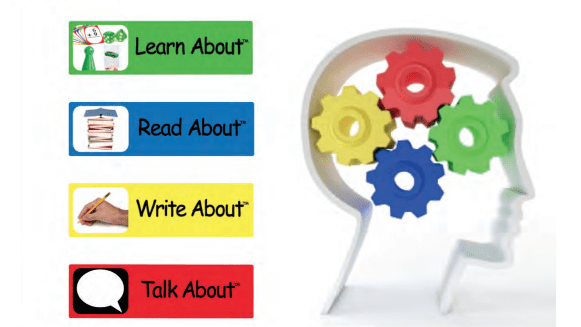
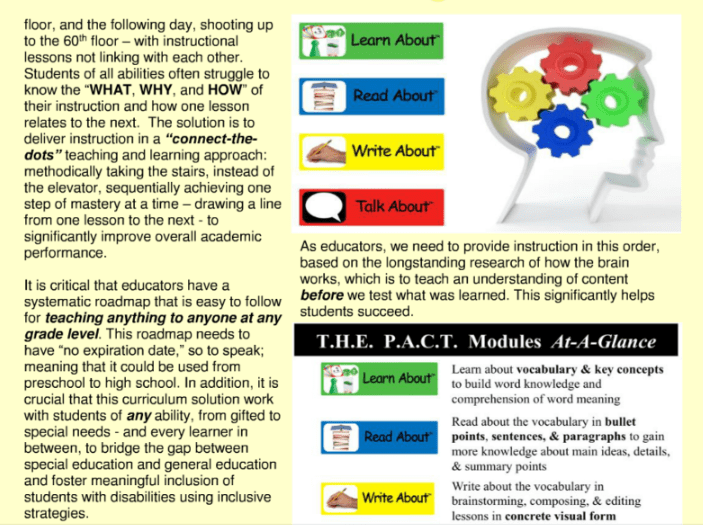
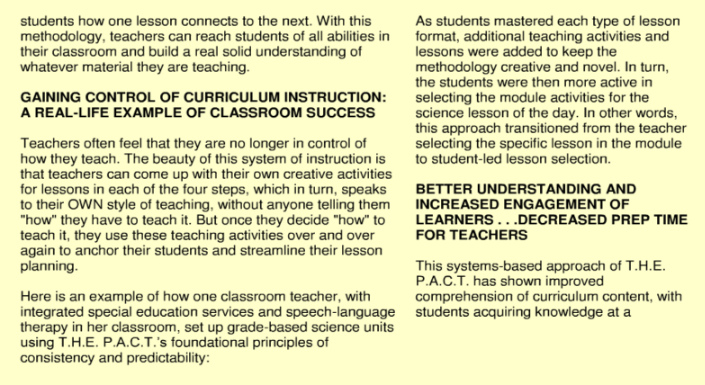
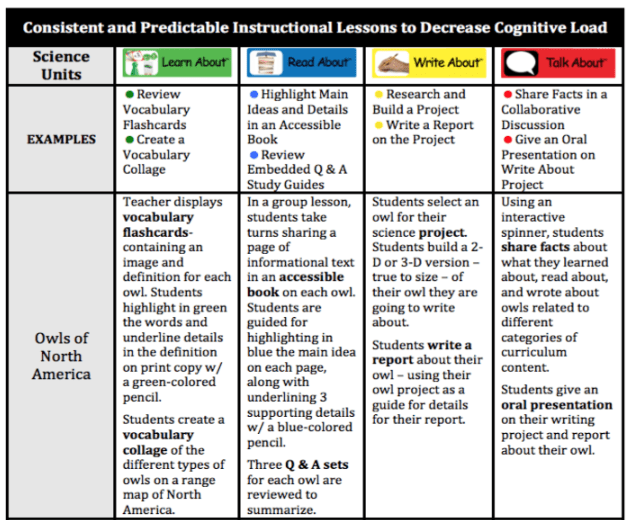
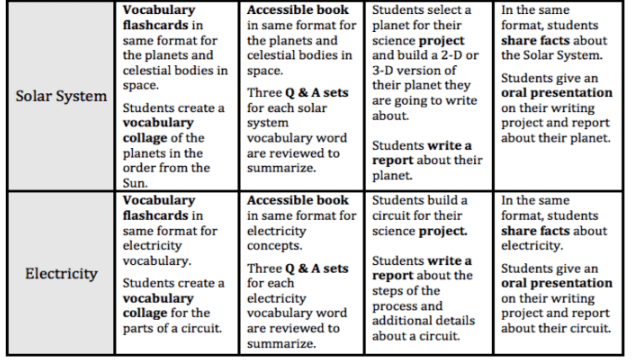
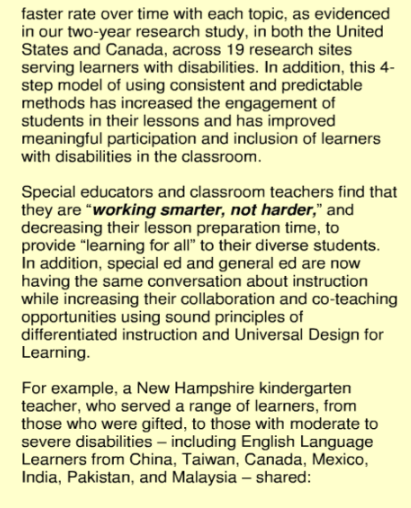
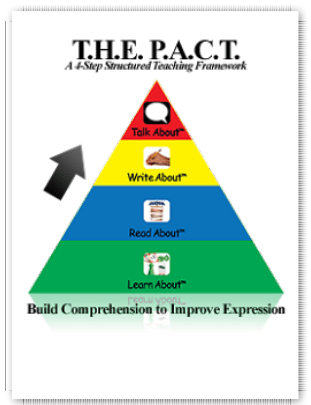
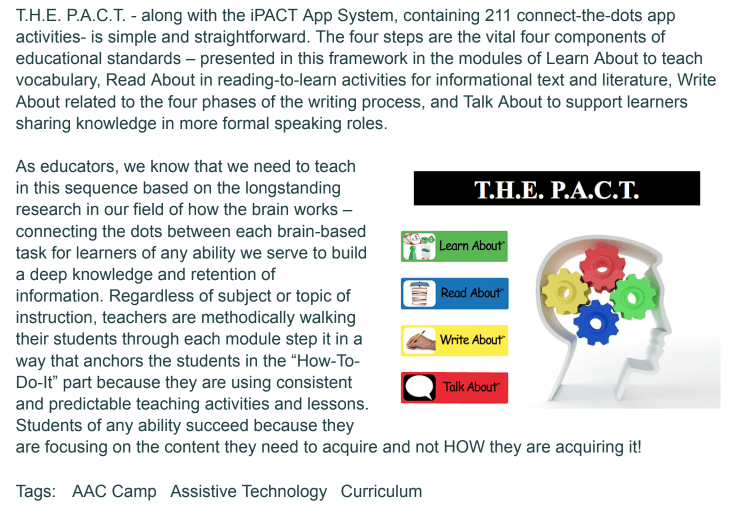
These four components are presented in the framework as a “Module System” – Learn About, Read About, Write About, and Talk About – aligned to the vital components of educational standards. Educators, from preschool to high school, are now gaining control of their instruction, decreasing their prep time, and meaningfully including learners with disabilities in their classrooms.
Teach the Way Our Brain Works
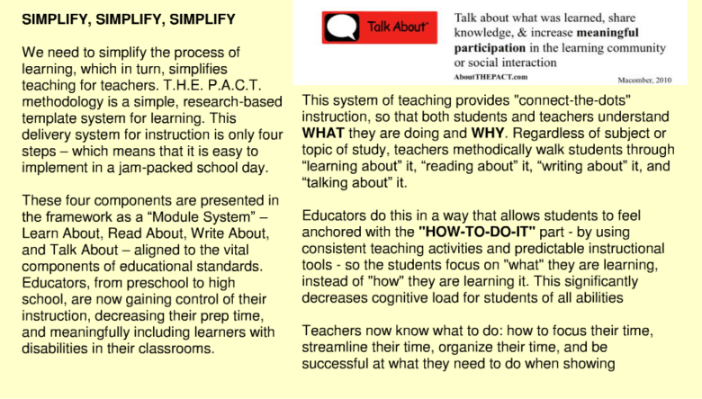
This system of teaching provides “connect-the-dots” instruction, so that both students and teachers understand WHAT they are doing… and WHY. Regardless of subject or topic of study, teachers methodically walk students through “learning about” it, “reading about” it, “writing about” it, and “talking about” it.
Educators do this in a way that allows students to feel anchored with the “HOW-TO-DO-IT” part- by using consistent teaching activities and predictable instructional tools – so the students focus on “what” they are learning, instead of “how” they are learning it. This significantly decreases cognitive load for students of all abilities.
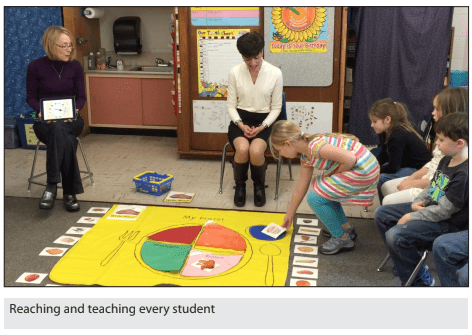
Reaching & Teaching Students of All Abilities
Teachers now know what to do: how to focus their time, streamline their time, organize their time, and be successful at what they need to do when showing students how one lesson connects to the next. With this methodology, teachers can reach students of all abilities in their classroom and build a true solid understanding of whatever material they are teaching.
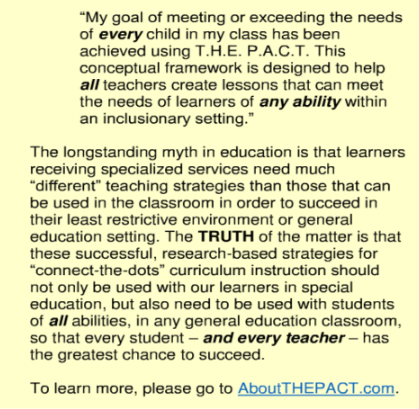
The longstanding MYTH in education is that learners receiving specialized services need much “different” teaching strategies than those that can be used in the classroom in order to succeed in their least restrictive environment or general education setting. The TRUTH of the matter is that these successful, research-based strategies for meaningful curriculum instruction should not only be used with our learners in special education, but also need to be used with students of ALL abilities, in ANY general education classroom, so that every student – and every teacher – has the greatest chance to succeed.
To learn more, please go to AboutTHEPACT.com.
Since completing a fellowship at Johns Hopkins Kennedy-Krieger Institute in 1988, Phyl Macomber has become an award-winning keynote speaker, author, and education specialist. Phyl has consulted with and trained thousands of teaching staff and was featured in the international best seller, the Common Threads Trilogy book series, as one of the top 100 empowering women who is a passionate catalyst for systems change in education.
Phyl has been a guest on numerous radio shows to discuss simplifying instruction for students of all abilities. Phyl serves two ambassadorships – the first for the educational affairs organization, I AM Living Education Everyday and the second at Energime University, based in Manhattan, as the educational co-producer of the University’s global youth program, Mission Earth Solutions. Her partnership with South Africa-based Leave No Girl Behind International is training young people in key leadership principles globally.
Phyl has created a 4-step simple system for how to teach anything to anyone, called T.H.E. P.A.C.T., which is outlined in Phyl’s first book, The Power of T.H.E. P.A.C.T. Her research-based teaching strategies have been published in numerous articles featured in education publications since 2009 and are being successfully used across North America and in parts of Australia, Italy, Saudi Arabia, and Africa.
Impact of two different infographics types “interactive- static” on developing mathematical concepts among female students at second grade intermediate in the Kingdom of Saudi Arabia
Mohamed Shaltout1and Hania Fatani2*
1Department of Education Technology, Arab East College For Graduate Studies, Saudi Arabia. 2Supervisor of Learning Resources, Yanbu City, Ministry of Saudi Education, Saudi Arabia.
Article History
Received 16 August, 2017 Received in revised form 20 September, 2017 Accepted 25 September, 2017
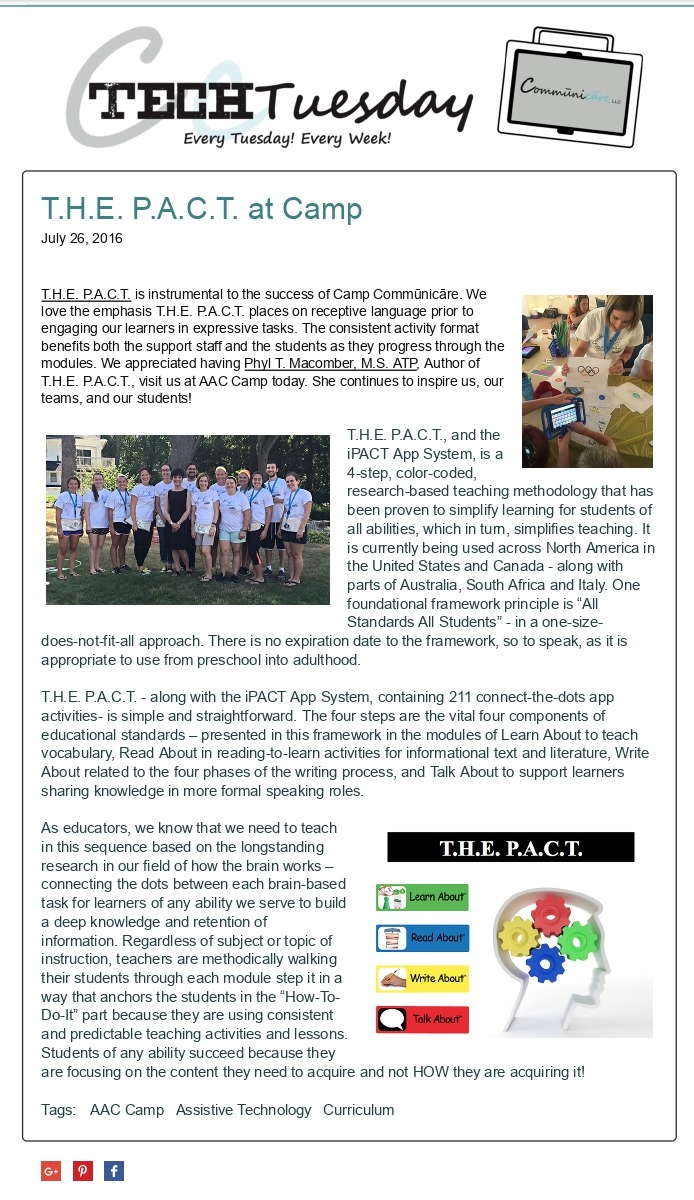
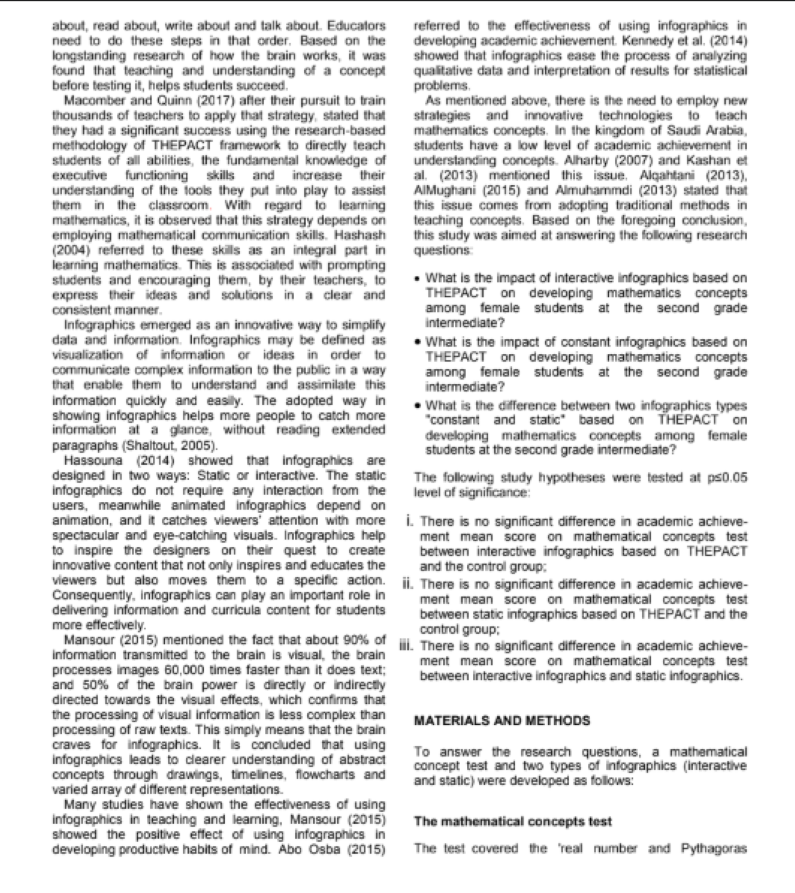
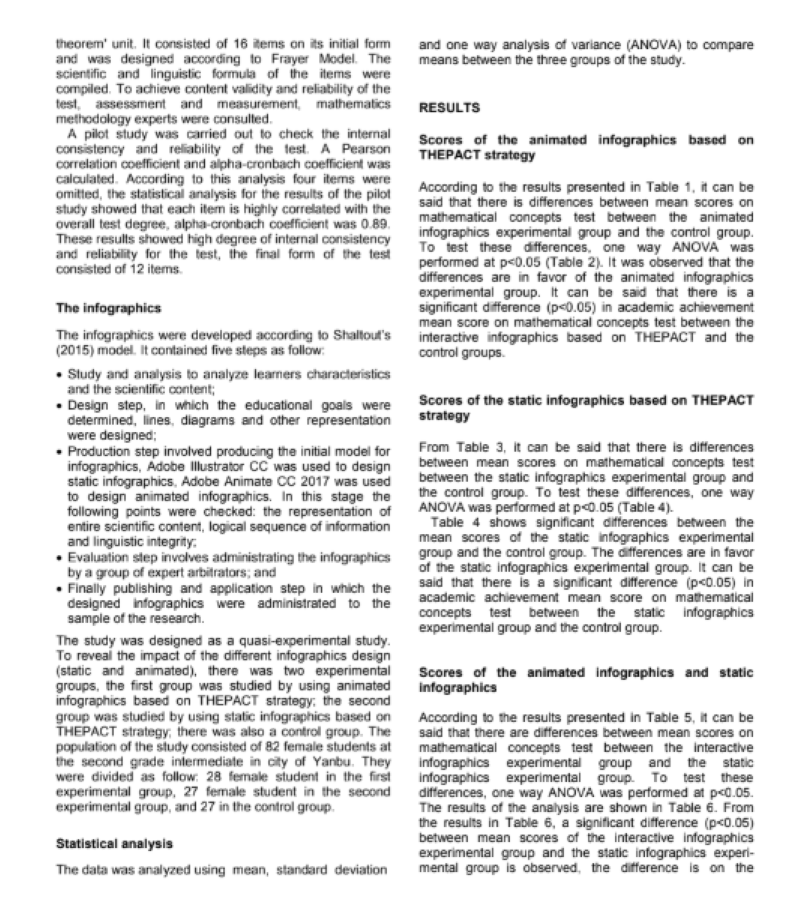
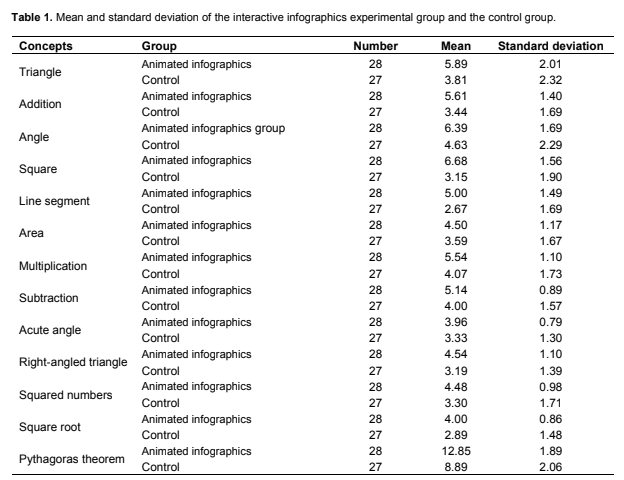
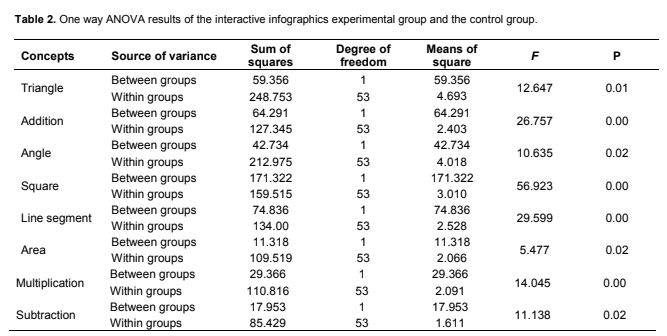
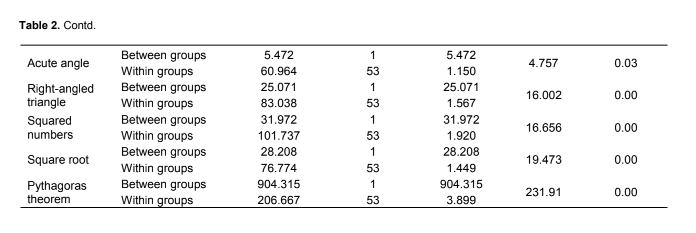
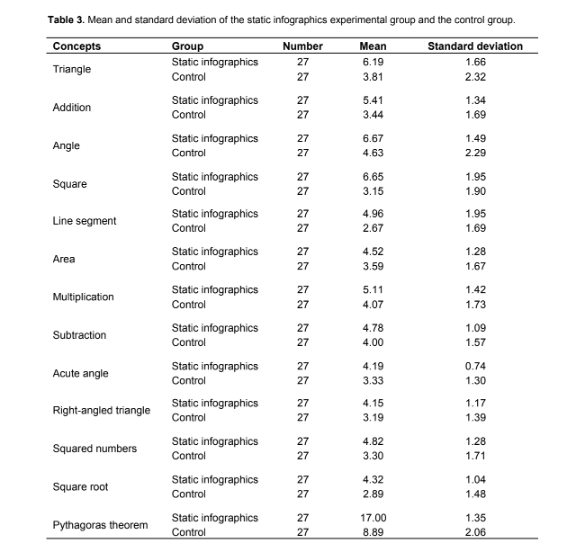
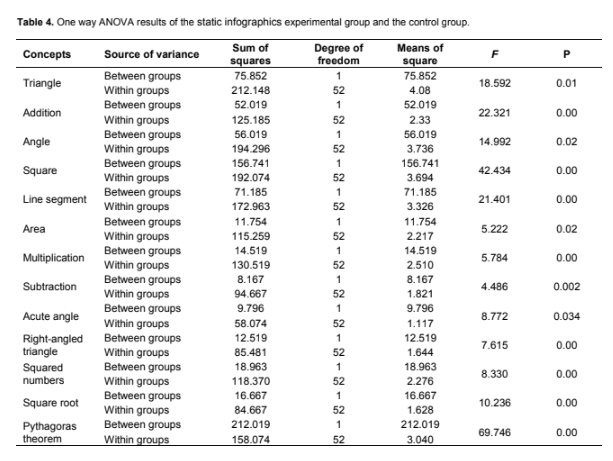
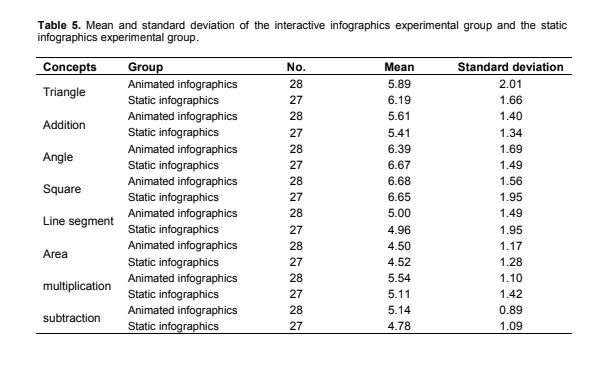
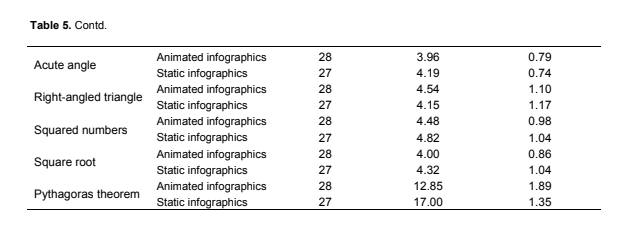
This study was aimed at identifying the impact of two infographics types (interactive and static), on developing mathematical concepts among female students at second grade intermediate in the Kingdom of Saudi Arabia. A quasi- experimental approach was adopted; the population of the study consisted of 82 female students. The students were divided into three groups: An experimental group studied by using animated infographics based on, ‘technology helps easy and practical accessible curriculum teaching (THEPACT) strategy, an experimental group studied by using static infographics based on THEPACT strategy, and a control group studied by using traditional method. Real numbers and Pythagoras theorem were reformulated by using infographics, an achievement test of mathematical concepts was also prepared, hypotheses were formulated and tested. The data obtained were analyzed using mean, standard deviation and one way analysis of variance at p≤0.05. The results of post application of the achievement obtained reveal a statically significant difference (p≤0.05) between the mean scores of control group and the experimental groups. The difference is in favor of the experimental groups. The results obtained also reveal statically significant differences between mean scores of the two experimental groups on some concepts, the differences were in favor of the static infographics based on THEPACT strategy.
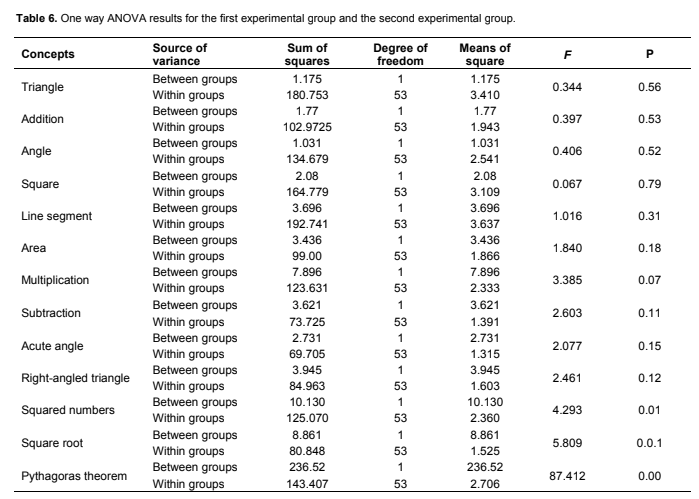
following concepts: Squared numbers, square root and Pythagoras theorem. The differences are in favour of static infographics experimental group (based on THEPACT strategy). As a result of this analysis, it can be said that there is a significant difference (p˂0.05) in
academic achievement mean score on mathematical concepts test between the interactive infographics experimental group based on THEPACT strategy and the static infographics experimental group based on THEPACT strategy.
DISCUSSION The results shown above has proven the positive impact of using infographics (static and animated) based on THEPACT strategy on developing mathematical concepts achievement. Using infographics based on the THEPACT strategy prompts female students to participate on all learning activities. This helps teachers and students to accomplish educational goals more effectively. Using infographics can also create a rich education environment with visual stimuli and sensory experiences. It was also noticed that students in the two experimental groups have more opportunities for social interaction which contributed to increasing and improving their motivation to learn, communicate and swap ideas in the classroom. Representing concepts through infographics helps make abstract concepts more concrete. Using infographics features like colors, shapes, arrows and symbols helped to illustrate the mathematical concepts in a fascinating way. This way of representing concepts seemed more attractive for students than reading about it in textbooks. The findings of similar studies indicated that infographics help learners to cope with difficult and complicated information. It helps learners to understand courses’ content and improves immediate and postponed academic achievement (Diezmann and Lowerie, 2010; Sudakov et al., 2014; Ching, 2013). With regard to comparing between animated and static infographics, previous results revealed that illustrating new concepts for students, like squared numbers, square root and Pythagoras theorem, static infographics is easier for students to deal with, especially when learning new concepts. Meanwhile, the comparison between the two types of infographics did not reveal any significant difference for the rest of the concepts.
REFERENCES Abo Osba S. (2015). Impact of using infographics strategy on academic achievement among fifth grade female students and their attitudes and motivation towards learning science. Unpublished master thesis, Nablus: Alnajah University. Alharby M. (2007. Requirements of using e-learning to teach high school Mathematics from the practitioneers and specialists’
Almughani M. (2015). Technological enlightenment level among mathematics teachers at primary stage in governorate of soart obeida. Unpublished master thesis, Riyadh: Imam Mohammed Ben Saud Islamic University. Faculty of Social Science. Almuhammdi N. (2013). An awareness study of reality of using female teachers and supervisors for technology and computers in light of NCATE standards for total quality in Saudi Arabia. Math. Educ. 16(1):62-111. Alqahtani O. (2013). Reality of employing innovative technologies in teaching developed curricula from teachers and supervisors point of view at Tabuk area. Int.l Interdiscipl. J. Educ. 2(5):407-430.
Ching H. (2013). Effects of multimedia based graphic novel presentation on critical thinking among students of different learning approaches. Turk. Online J. Educ. Technol. 12(4):56-66. Diezmann C. & Lowerie T. (2010). Students as decoders of graphics in mathematics. A paper presented in the proceeding of Shaping the Future of Mathematics Education, July, 3-7, Fremantle, Western Australia. Hashash K. (2004). Mathematical communication and representation among students at the upper stage in Jordan in light of NCTM (2000) standards. Unpublished doctoral thesis, Amman: Arabian Amman University. Hassouna I. (2014). Infographics in education. A paper presented in proceedings innovative technologies in information era, Gaza: Alaqsa University. Kashan K., Mosfar S. & Othman I. (2013). Extent of mastery of skills teaching mathematical concepts among mathematics teachers in primary stage in Kingdom of Saudi Arabia. Journal Arabian Gulf Message. 129:75-94. Kennedy J., Abichandani P., Fontecchio A. (2014). Using infographics as a tool for introductory data analytics education in 9-12. A paper presented in the proceeding of “The IEEE Frontiers in Education Conference”, Oct. 22-25, Madrid, Spain. Macomber Ph. & Quinn F. (2017). Command central for the brain, the importance of “coonect-the-dots”, lessons for teaching executive functioning skills. Closing the gap, issue October/November. Pp. 20- 24. Macomber Ph. (2016). Jam-Pact ideas for building solid curriculum knowledge: The evidence-based “cure for the common core”. Closing the gap, issue April/May. Pp. 14-19. Mansour M. (2015). Impact of using infographics based on Marzano’s dimensions of learning model on developing e-cloud concepts and productive habits of mind among students at faculty of education. Journal of Faculty of Education, Assiut University. 31(5):126-167. Rashed M. & Kashan K. (2009). Mathematics curricula and its teaching methods for main stages. Amman: Dar Aljanadria for publishing and distribution. Shaltout M. (2015). Interactive infographics educational model, a paper presented at proceedings of global educational forum “when creative educational ideas emerge”. Dubai. Sudakov I., Bellsky T., Usenyuk, S. & Ploykova V. (2014). Mathematics and climate infographics: A mechanism for interdisciplinary collaboration in the classroom. Unpublished Master Thesis, University of Utah: Department of Mathematics.
2017 Summer Edition of Living Education eMagazine
The Top 5 Strategies Every Teacher Can Easily Use in Any Classroom Macomber & Preston
2017 Summer Edition of Living Education eMagazine
The Top 5 Strategies Every Teacher Can Easily Use in Any Classroom Macomber & Preston
2017 Summer Edition of Living Education eMagazine
The Top 5 Strategies Every Teacher Can Easily Use in Any Classroom Macomber & Preston
2017 Summer Edition of Living Education eMagazine
The Top 5 Strategies Every Teacher Can Easily Use in Any Classroom Macomber & Preston
2017 Summer Edition of Living Education eMagazine
The Top 5 Strategies Every Teacher Can Easily Use in Any Classroom Macomber & Preston
2017 Summer Edition of Living Education eMagazine
The Top 5 Strategies Every Teacher Can Easily Use in Any Classroom Macomber & Preston
2017 Summer Edition of Living Education eMagazine
The Top 5 Strategies Every Teacher Can Easily Use in Any Classroom Macomber & Preston
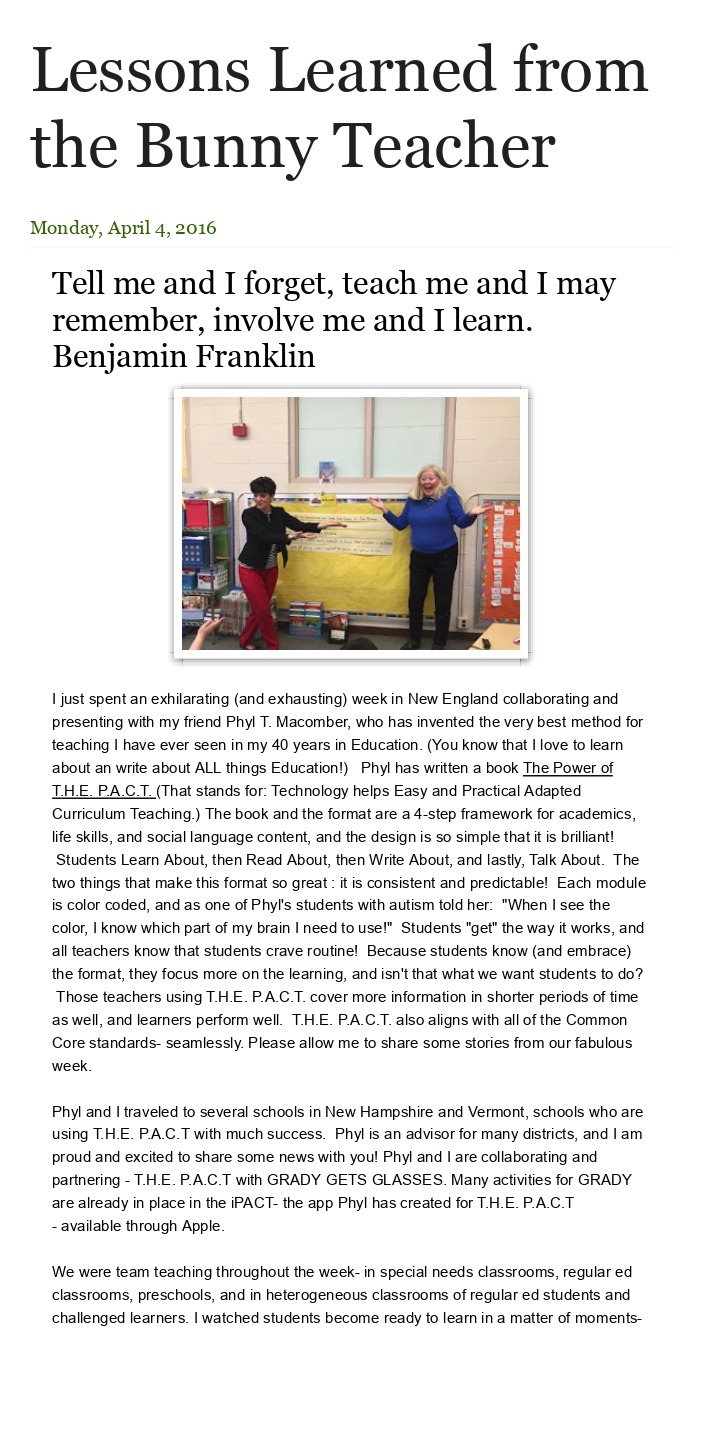
Lessons Learned from the Bunny Teacher
Monday, April 4, 2016
Tell me and I forget, teach me and I may remember, involve me and I learn. Benjamin Franklin
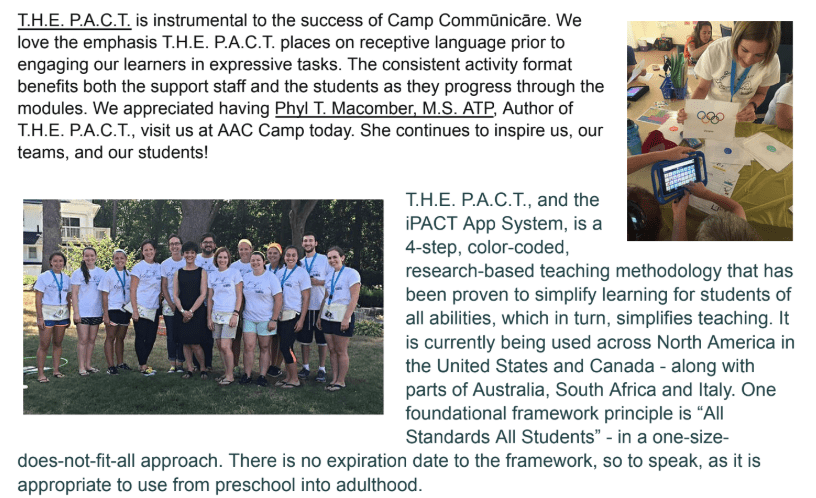
I just spent an exhilarating (and exhausting) week in New England collaborating and presenting with my friend Phyl T. Macomber, who has invented the very best method for teaching I have ever seen in my 40 years in Education. (You know that I love to learn about an write about ALL things Education!) Phyl has written a book The Power of T.H.E. P.A.C.T. (That stands for: Technology helps Easy and Practical Adapted Curriculum Teaching.) The book and the format are a 4-step framework for academics, life skills, and social language content, and the design is so simple that it is brilliant! Students Learn About, then Read About, then Write About, and lastly, Talk About. The two things that make this format so great : it is consistent and predictable! Each module is color coded, and as one of Phyl’s students with autism told her: “When I see the color, I know which part of my brain I need to use!” Students “get” the way it works, and all teachers know that students crave routine! Because students know (and embrace) the format, they focus more on the learning, and isn’t that what we want students to do? Those teachers using T.H.E. P.A.C.T. cover more information in shorter periods of time as well, and learners perform well. T.H.E. P.A.C.T. also aligns with all of the Common Core standards- seamlessly. Please allow me to share some stories from our fabulous week.
Phyl and I traveled to several schools in New Hampshire and Vermont, schools who are using T.H.E. P.A.C.T with much success. Phyl is an advisor for many districts, and I am proud and excited to share some news with you! Phyl and I are collaborating and partnering – T.H.E. P.A.C.T with GRADY GETS GLASSES. Many activities for GRADY are already in place in the iPACT- the app Phyl has created for T.H.E. P.A.C.T – available through Apple.
We were team teaching throughout the week- in special needs classrooms, regular ed classrooms, preschools, and in heterogeneous classrooms of regular ed students and challenged learners. I watched students become ready to learn in a matter of moments- because they KNEW the format and the steps to learning. Because the format is consistent and predictable, students are actually more ready to learn. And every learner is involved- every time! I loved this line from a 3 year old in a preschool we visited. The child saw Phyl, walked over to the special rug, sat down, and said “First, we do Learn About!” (this was only Phyl’s third session in this school, and the child already knew the routine). After a very fun spinner game for the Learn About section, (important vocabulary concepts) I presented the “Read About” section- with GRADY GETS GLASSES. Phyl and I team taught the Write About and Talk About modules- all in about 40 minutes, with 100% student involvement and great success. I observed the same kinds of success with students who had one or many learning challenges, and with bright second graders. (By the way, Phyl has four years of internationally based research to endorse her fabulous product. Check out her website)
Additionally, I attended some training sessions for T.H.E. P.A.C.T. with Phyl, and had the chance to see firsthand the way activities can be created, converted, and cloned. If only this technology would have existed when I was in the classroom! Teacher prep time is so minimal- and so easy! Here is the essence of what I learned this week- and I am so thrilled that GRADY GETS GLASSES is a part of such an innovative program! Take a look, and I feel sure you will want to visit her website. If you are a school administrator, T.H.E. P.A.C.T may be just the tool you need to turn your school into a high-performing school.
What is T.H.E. P.A.C.T.?
Research-Based 4-Step Teaching Framework
Bridges the Gap Between General Education & Special Education
Provides a Blueprint for Universal Design for Learning
Systemizes Instruction for Learners & Teaching Staff
Directly Aligned to the Common Core Standards
I encourage you to take a look at the website http://aboutthepact.com/
As always, I welcome your comments and suggestions. This post was written with the permission of Phyl Totaro Macomber.
Rittman Publishing, LLC ®
Visit Dede’s webpage for complete details on her award-winning book, STUDENT TEACHING: THE INSIDE SCOOP FROM A MASTER TEACHER. Many colleges have made the book required reading.
Signed copies are available www.dederittman.com Dede is also a national speaker on The Three C’s for Classroom success: Confidence, communication, and Creativity; Avoiding Teacher burnout; and many other inspirational topics.
Contact Dede if you would like her speak to your faculty or student teachers. dederittman@gmail.com
I LOVE writing. And I love writing children’s books- my newest passion. Although it will be a ton of work, I am looking forward to selling my books. Since I was a secondary teacher, I know that I have much to learn about elementary students, and I will have to follow my own advice and be my genuine self. However, I also know that I am passionate about helping kids who have to wear glasses, and that GRADY GETS GLASSES sends a positive message. I am willing to work hard and do all the things that also made me a successful teacher for 37 years. I remain inspired!
Here is the link the my 15 second Grady Gets Glasses commercial! https://www.youtube.com/watch?v=881Z3e34X9s
Teacher friends- let me know if you want me to read GRADY GETS GLASSES at your school. I am willing to come in to discuss the creative writing process, why writing is important, and personal fulfillment through writing, along with reading my book. I would appreciate the exposure, and I would make signed copies available for purchase in your classrooms following the reading. Please email me at dederittman@gmail.com . The website www.gradygetsglasses.com IS UP AND RUNNING!!!. Signed copies ARE available! Coloring books and Grady plush toys are ordered! Please like Dede’s new page -Grady Gets Glasses- for updates about her children’s book. https://www.facebook.com/gradygetsglasses?ref=hl
February 10, 2016/0 Comments/in Happiness, Inspiration, Joy /by Kate Gardner
By: Phyl Macomber, President of Make A Difference, Inc., Author of “The Power of T.H.E. P.A.C.T.” and Education Specialist
Since completing a fellowship at Johns Hopkins Hospital’s Kennedy Krieger Institute in 1988, I have trained and consulted with literally thousands of classroom teachers, special education staff, and parents of children with disabilities across North America and in parts of Europe. Unfortunately, I can say that many of the same problems that existed then continue to persist in education today, regardless of the year on the calendar or geographic location.
As the author of the research-based teaching framework called T.H.E. P.A.C.T., I have successfully helped countless educators gain control of their instruction and produce the results that they need to reach each individual student they serve, both in general education and in special education. It has been so rewarding seeing all students – including those students with disabilities – be successful in general studies classrooms.
If you are a teacher, you know that you can barely keep your head above water. Each day, you walk into your school, go inside your classroom, or arrive in your learning center – and face trying not to drown with a heavy workload and dizzying array of initiatives. But, most importantly, you show up each day trying to make a difference. If you are a parent of a child with a disability, you may simply want your child to be engaged when learning, to be eager to participate, and to be a contributing class member to share their knowledge – just like every other student in the classroom. And you are probably thinking, “Does it have to be so hard?”
Classroom teachers attempt to cover an incredible amount of information in an unrealistic, often impossible, amount of time. I have experienced these struggles firsthand because I, too, only have 180 seconds to go to the bathroom during a typical day!
Instruction in today’s educational system is typically delivered in days filled with multiple things to do and just not enough time to do them – with people often feeling VERY under-appreciated. I know this because I spend a great deal of time in schools, mentoring and coaching staff – showing them how to deal more effectively with these very problems so that they consistently get more results from their time.
Under a positive umbrella, what parent of a child with a disability would not want to get a call from their school to say that a meeting needed to be scheduled because their child had MET all of his or her education goals BEFORE the targeted time?
Matthew’s mom received just such a phone call . . .
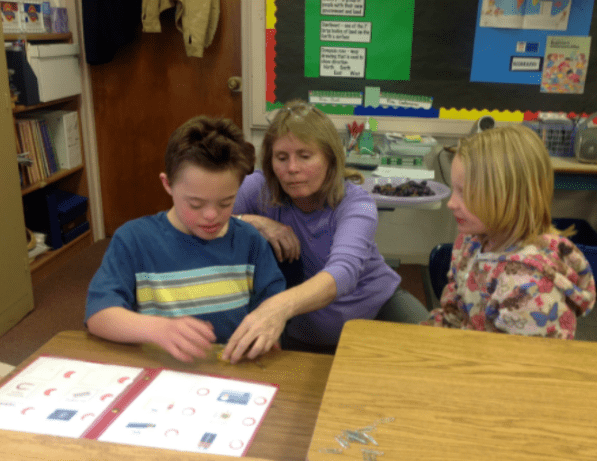
Matthew was a third grader with Down Syndrome whose teacher embraced a “learning-for-all” philosophy in her classroom using T.H.E. P.A.C.T. Mrs. Woolridge, along with the classroom support staff member, “Mrs. C,” discovered after teaching the very first science unit of the year, that this method of teaching could be used with students of ALL abilities – from gifted to special needs, and every student in between – for ANY subject on ANY topic in school.
This third grade teacher anchored her students, including Matthew, in the four basic steps of T.H.E. P.A.C.T. – Learn About, Read About, Write About, and Talk About – when teaching ANYTHING in her classroom. Mrs. Woolridge used consistent teaching activities, ranging from vocabulary games to hands-on projects. Matthew accessed these classroom activities at his learning level and fully participated with his classmates. And, for the first time ever in elementary school, Matthew was able to give an oral presentation to share all of his knowledge in front of his peers.
At that moment, the eyes of all the adults working in that classroom were filled with tears of emotion as they observed the true meaning of inclusion.
Near the end of the school year, when Matthew’s classroom support staff person, Mrs. C, was going to be out of the building the following day attending one of my seminars, Mrs. Woolridge announced to the third grade class that a substitute classroom helper was going to be there working with Matthew and some of the other children in the third grade. Many of the students were very confused by this. Abby, one of Matthew’s classmates (who also had a big crush on him), shared: “Why does Matthew need a sub to help him? We are ALL using T.H.E. P.A.C.T. in class, Mrs. Woolridge. We can just help him if he needs it – and then he can help us, too! We’ve got this!”
BRILLIANT. Learning for all, indeed!
There has been such a huge gap between what classroom teachers do and what special educators need done to include children with disabilities – such as those students with autism, Down Syndrome, learning disabilities, and attention deficit disorders to name a few – in their general studies classrooms in a meaningful way. And the key word here is “MEANINGFUL.”
The longstanding MYTH in education is that, in order to succeed, students receiving specialized services need much “different” teaching strategies than those that can be used in the regular classroom. That is flat-out wrong.
The TRUTH of the matter is that the successful, research-based strategies used with our learners in special education – such as those used in T.H.E. P.A.C.T. – benefit and should be used with, students of all abilities in ANY general education classroom.
This successfully bridges the gap between special education and general education.
The teaching method needs to work for learners above grade level, at grade level, and below grade level in order to provide an “INCLUSIVE” model of education worldwide. This method also needs to work to support parents – especially when assisting their kids with homework and building the necessary social skills and community skills for their children to be successful.
Students with disabilities do not “earn” their way into the general education classroom. It is their basic right to be there.
The teaching method of T.H.E. P.A.C.T. simplifies learning for children of all abilities, which, in turn, simplifies teaching for teachers at all grade levels .In fact, my “PHYL-osophy” is that “ALL EDUCATION IS SPECIAL.”
Until next time, Thanks for reading.
Love From Phyl xx Contact Info: Phyl@AboutTHEPACT.com www.AboutTHEPACT.com www.Facebook.com/Phyl.THEPACT (802) 484-3537
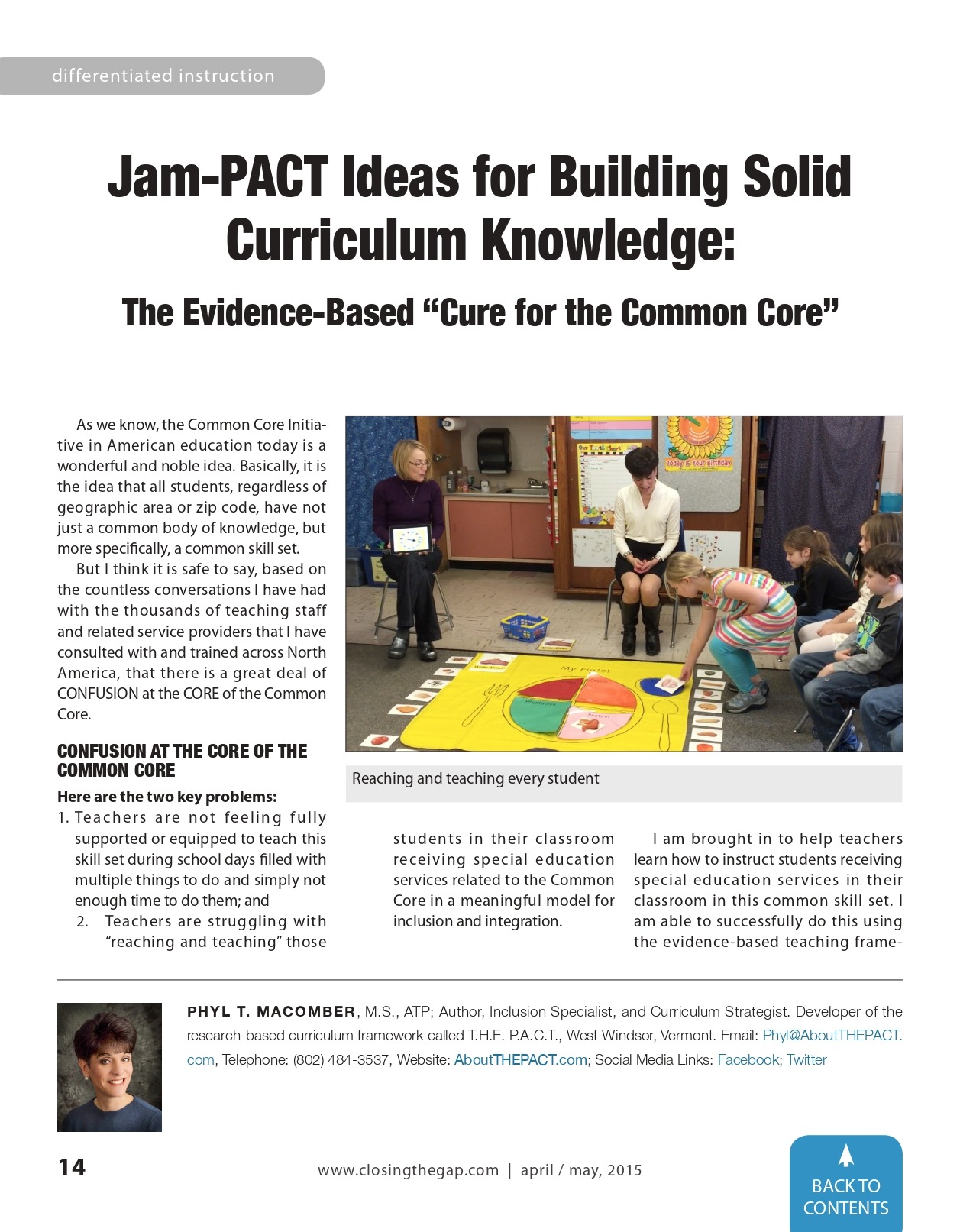
Jam-PACT Ideas for Building Solid Curriculum Knowledge:
The Evidence-Based “Cure for the Common Core”
As we know, the Common Core Initiative in American education today is a wonderful and noble idea. Basically, it is the idea that all students, regardless of geographic area or zip code, have not just a common body of knowledge, but more specifically, a common skill set. But I think it is safe to say, based on the countless conversations I have had with the thousands of teaching staff and related service providers that I have consulted with and trained across North America, that there is a great deal of CONFUSION at the CORE of the Common Core.
work called T.H.E. P.A.C.T.™ that I have authored, in addition to the fact that my main area of expertise since completing a fellowship at Johns Hopkins Hospital’s Kennedy-Krieger Institute in 1988 has been in the field of special education.
“THE CURE FOR THE COMMON CORE”
I share with teachers hundreds of ways of imparting this common skill set to the special education students in their classroom using the research-based teaching strategies of T.H.E. P.A.C.T.™ framework.
The results?
• The teachers are thrilled.
• I, too, am thrilled when they say to me, “Wait a minute here, Phyl. The strategies that you are giving me here are working really well with ALL THE STUDENTS in my classroom!”
In fact, T.H.E. P.A.C.T.™ is now being called “The Cure for the Common Core” and is a four-step roadmap for teaching anything.
These steps are the vital four components of the Common Core Standards, presented in this framework in a four module approach to teaching:
As educators, we need to do these things in this order, based on the long standing research of how the brain works
understand WHAT they are doing and WHY. Regardless of subject or topic of study, teachers walk their students through learning about it, reading about it, writing about it and talking about it – across a total of 10
The result has been that teaching staff know how to focus and organize their time – receiving jam-PACT ideas for creative activities and teaching tools – so that they have true clarity of an instruc tional roadmap.
This article will share information
– which is to teach an understanding of content before we test what was learned.
THE IMPACT OF T.H.E. P.A.C.T. – THE EVIDENCE BEHIND THE CURE
Longstanding research shows that a great amount of time and brainpower are required to learn new information. Time and time again, learners spend too much cognitive focus figuring out “how” they are supposed to do something instead of concentrating on “what” the content is that they are learning.
In an IRB approved research study in both the United States and Canada, our 18 research sites are finding the same things. Simply put:
• Learners are learning faster with instruction time decreasing
• Teacher prep time has drastically reduced
In this multiple, single-subject design research study, titled – The Impact of T.H.E. P.A.C.T. – learners in special education, across a variety of grade levels and disabilities, are succeeding with building a solid understanding of what they need to learn and are eager to share what they know. Students participating in the research study include those with developmental disabilities, varying verbal and nonverbal learning disabilities, autism spectrum
instructional activities in the research study related to the four modules of T.H.E. P.A.C.T. They do this in a way so that the students feel anchored with the “how-to-do-it” part – by using these consistent teaching activities – so the students focus on WHAT they are learning, instead of HOW they are learning it.
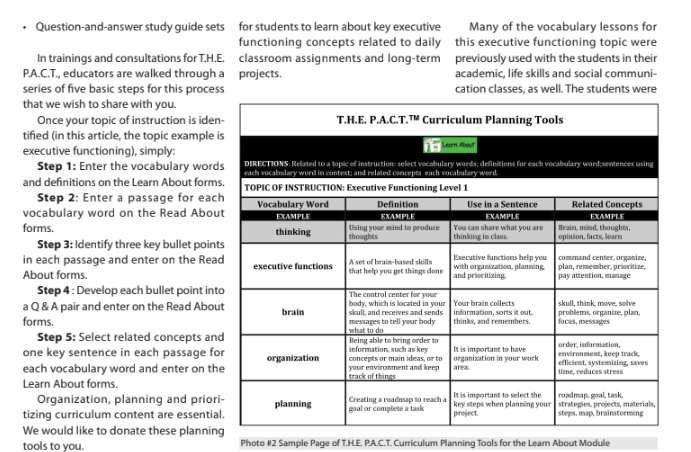
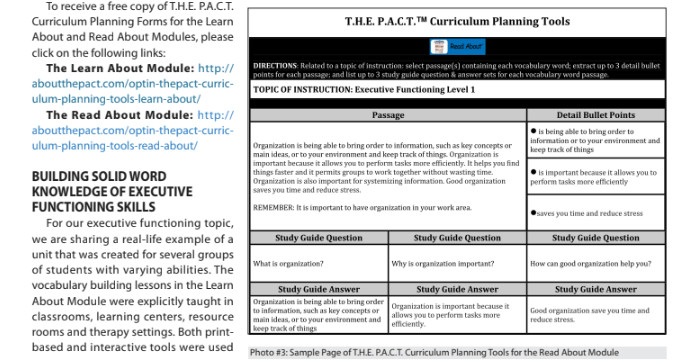
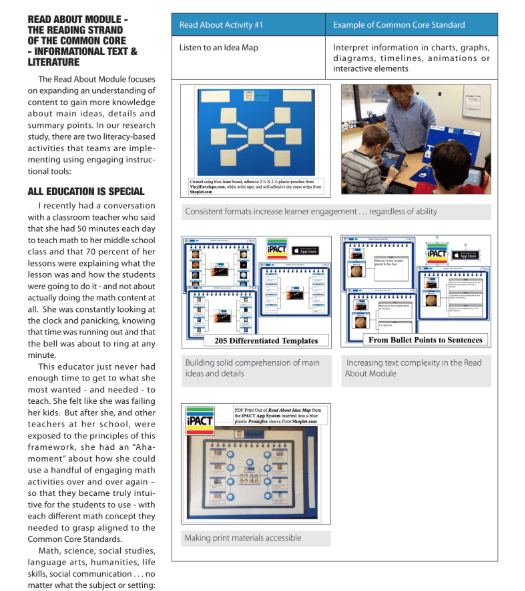
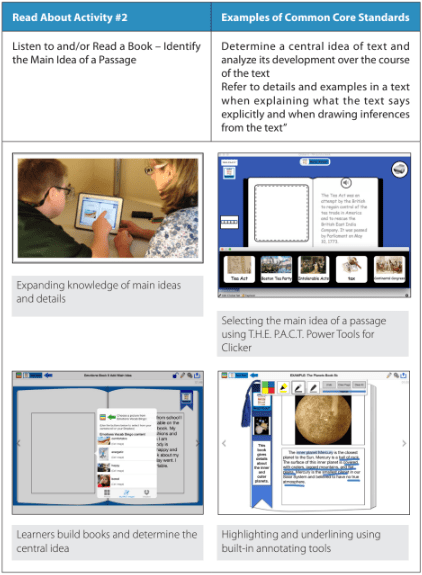
related to the first two modules of the T.H.E. P.A.C.T. – the Learn About™ Module and the Read About™ Module – to build curriculum knowledge, directly aligned to the Common Core Standards, as shown in the research study, The Impact
disorders, complex disabilities and intel lectual impairments. The locations of the research sites across North America include public school settings, autism programs, preschools and school-to
work programs. Topics of instruction include academics, life skills, social communication and vocational.
The study includes both the measure ment of learning outcomes and class participation of learners, along with staff satisfaction surveys regarding the use
of T.H.E. P.A.C.T. and learner outcomes. After obtaining baseline for each curric ulum topic, teaching staff methodically provide “connect-the-dots” teaching, so that both students and teaching staff
Anchoring students with consistent tools decreases cognitive load
Explicitly teaching all components of the curriculum
These teaching activities are used over and over again – with each topic of instruction – to anchor students and streamline lesson planning. Students know:
• What to do;
• How to do it; and
• How to then share it
of T.H.E. P.A.C.T. It will outline consis tent teaching activities and multiple examples of creative teaching tools that you, too, can replicate in your own geographic area, using any tool of your choice!
LEARN ABOUT MODULE – THE LANGUAGE STRAND OF THE COMMON CORE
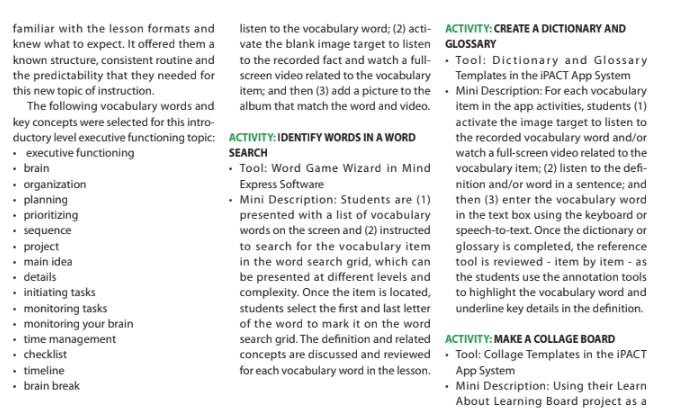
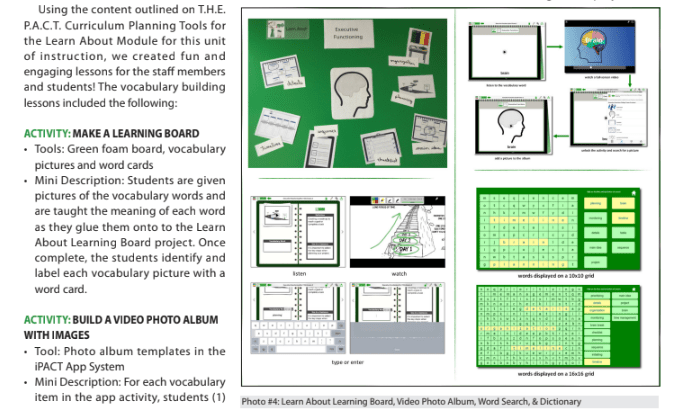
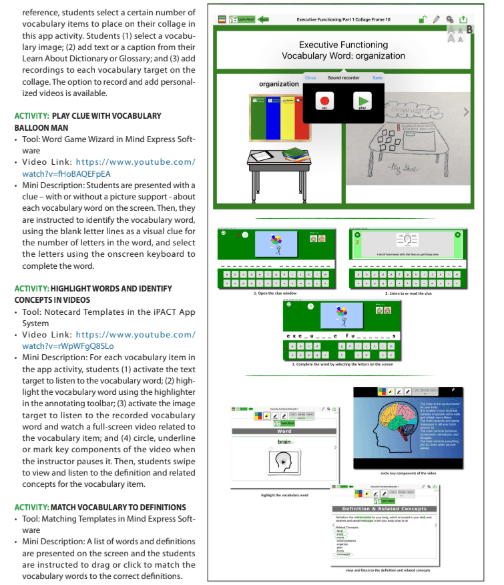
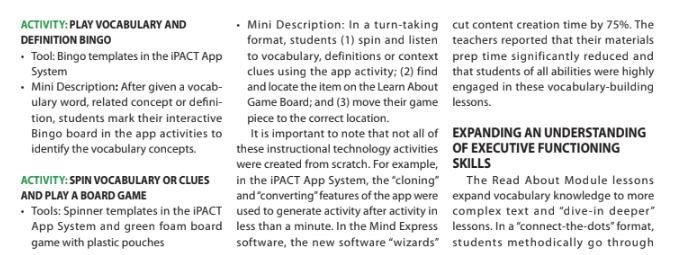
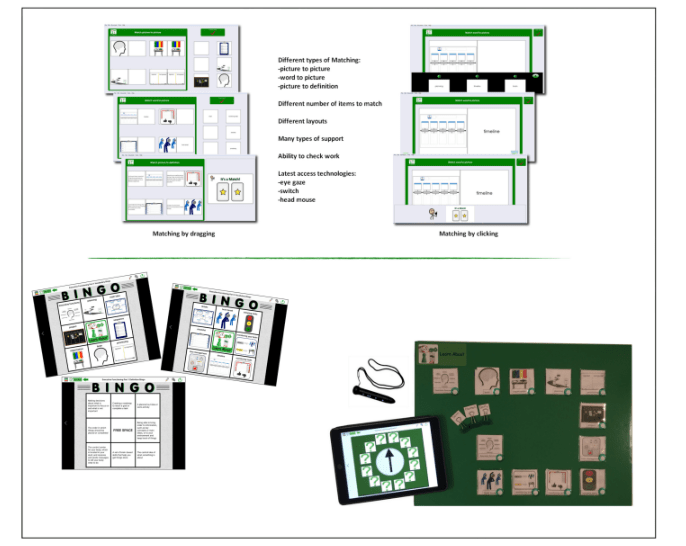
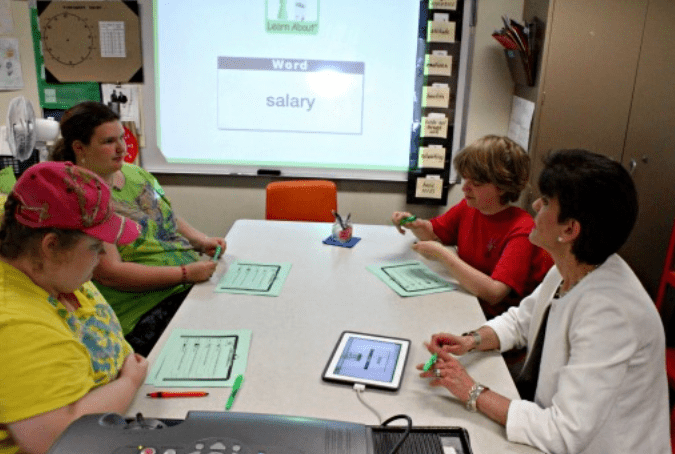
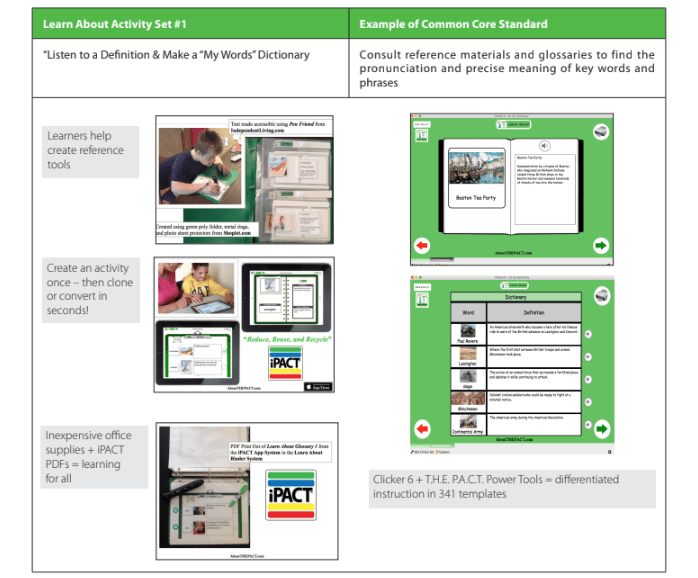
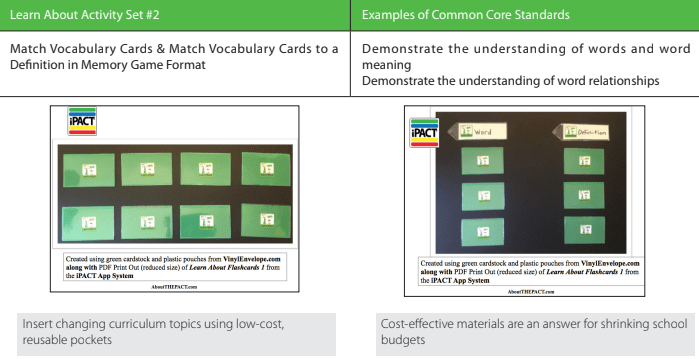
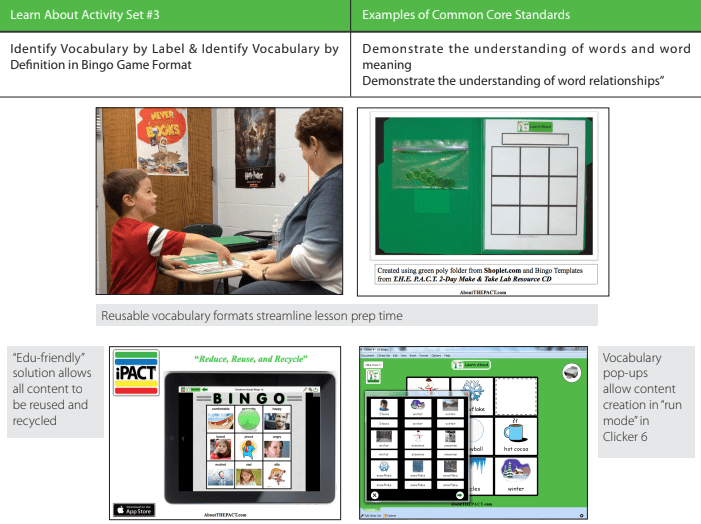
The Learn About Module focuses on building word knowledge and improves understanding of word meaning. In our research study, there are three vocabulary-building activity sets that teams are implementing using very creative teaching tools:
Teaching staff can teach anything using this instructional roadmap
Learners can learn anything using this brain-based framework I am excited about the application of these instructional strategies to all students in the classroom – from gifted to special needs, and every student in between – because I firmly believe, just like I am sure you do, that all education is special.
RESOURCE INFORMATION: iPACTTM App System: Apple App Store. For more information, go to: theiPACT.com Development Team: Mark Larson, Fio Quinn and Phyl T. Macomber Produced by Marblesoft for Make A Difference, Inc. T.H.E. P.A.C.T. Power Tools Collection for Clicker 5 & 6. For more information, go to: About- THEPACT.com/store/
Development Team: Fio Quinn, Phyl T. Macomber and the Crick Software Technical Support Team
Clicker 6 by Crick Software. For more information, go to: CrickSoft.com
Macomber, P. (2010). The Power of T.H.E. P.A.C.T: The Solution to Adapting the Curriculum: Book 1. West Windsor, VT: Make A Difference, Inc.
Belonging and Beyond
The Importance of Human Connection in Education
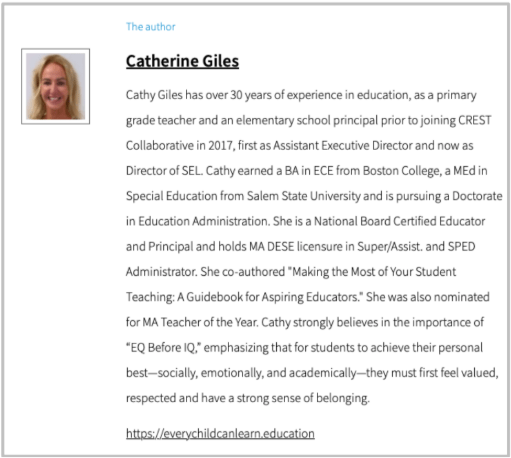
Authors: Phyl Macomber, International Education Specialist and Catherine Giles, Director of Social Emotional Learning
In every aspect of life, it is important to have a balance of expertise and humanity. This applies to leadership, education, multiple work industries, and personal relationships. So, what do these two things mean as it relates to educating our youth and teaching them about the real world?
The Balance of Expertise and Humanity
Expertise is a high level of knowledge or skill set in which you have a deep sense of understanding. Your expertise may set you apart as an expert. In the field of education, this could mean many things. If you are a classroom teacher, you may teach a particular subject that you specialize in or in which you hold a great deal of passion. If you are an educational consultant, you may have developed an expert knowledge base and “teach teachers” to elevate their instructional practice in key areas. Regardless of your specific role in education, your expertise gives the people you serve, both children and adults, confidence that you know what you are doing.
Expertise, however, is not just about what you know or about developing a bank of knowledge from which to draw upon. It is also about knowing how to apply that knowledge in diverse and unique situations. It is what you do with that knowledge that is the game changer.
To pair with your expertise is your humanity. This is your ability to connect with others and form positive relationships. Your humanity is what engages others to want to listen to you, to believe in themselves, and feel seen and valued.
In education, it is important to remember “connection before content.” Students need to know that they matter and that you want to get to know them individually, really know them, so that you can lift them up to be their best selves.
Whether you have served in education for one year or thirty years, we can guarantee you that those things that you hold dear in your memories are what we call “heart-tug” moments. These moments are times that you see a learner turn the corner in self-confidence and self motivation related to their social-emotional learning skills. A day in your classroom when you see a poor problem solver make a true, responsible decision. Or, a time when that withdrawn first grader looks up at you with tears in their eyes and says, “You made me believe in myself.”
Emotional Intelligence and Social Emotional Learning
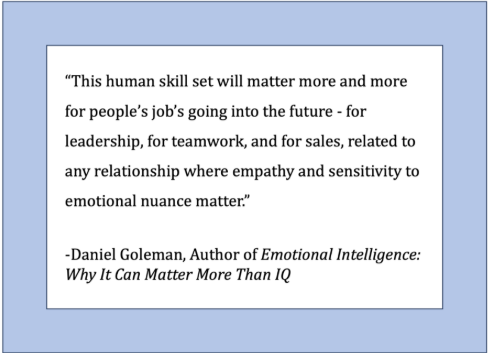
Emotional Intelligence (EI) refers to the ability to recognize, understand, express, and manage one’s emotions and feelings. Although the term originated in the mid-1980s, it wasn’t until 1995, with the publication of Daniel Goleman’s book Emotional Intelligence: Why It Can Matter More Than IQ (Goleman, 1995), that the theory of EI gained significant attention and became widely recognized. Today, thirty years later, EI has become a core component of hiring, recruitment, and employee training across organizations worldwide, including many Fortune 500 companies. So, why is this important to teach in education?
The answer to this question is that EI equips students of all abilities with the skills to understand and manage their own emotions, as well as those of others. This leads to improved self-awareness, empathy, and social skills – which are essential to both personal and academic success.
The Collaborative for Academic, Social, and Emotional Learning (CASEL), which was founded in 1994, brought emotional intelligence to the forefront of educational practices worldwide. CASEL’s mission is to promote and advocate for evidence-based social-emotional learning (SEL) to be an integral part of all students’ daily school experience.
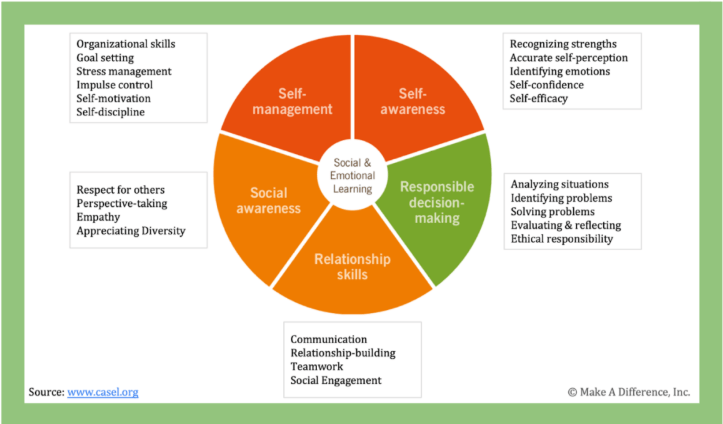
The CASEL Wheel identifies and classifies essential EI skills, often referred to as “employability” or “career-readiness” skills, into five competency areas: (1) self awareness, (2) self-management, (3) social awareness, (4) relationship skills, and (5) responsible decision-making. Skills such as recognizing and managing intense feelings, identifying the thoughts and behaviors that go along with them, and demonstrating empathy towards others are crucial EI skills. Also, building healthy relationships and setting personal boundaries are important skills to learn. To develop more emotional intelligence, students need to learn to resolve conflicts respectfully and make thoughtful decisions.
These EI skills help our students to become kind, caring and responsible “humans.” We hope you agree that no one or no thing can teach our students how to become emotionally intelligent humans better than us, their human educators! Our experience as educators tells us that these skills cannot be acquired through exposure alone, nor can they be learned by “osmosis.” If this were true, major corporations would not be investing millions of dollars annually to develop and strengthen the EI of their leaders and employees. To maximize the learning of students’ EI skills, we must be intentional and explicit with our SEL instruction, just as we are with our instruction in other academic content areas. This means that we need to purposefully embed EI skills into our daily lessons across all content areas.
Modeling EI skills in relevant ways and taking advantage of any EI “teachable moments” throughout the day will allow students to connect the skills they are learning to meaningful, real-life experiences. And finally, students must have multiple, repeated opportunities to practice their newly acquired skills before they are able to generalize and apply them in their daily lives. This allows them to achieve at their personal best—socially, emotionally, and academically.
Teacher Struggles
So, how do we find time to do this during a busy academic year?
Each day, we walk into our school, go inside our classroom, arrive at our learning center, or enter our therapy setting – and face trying to simply keep our head above water. But, most importantly, as educators, we show up each day trying to make a difference. We attempt to cover an incredible amount of information in an unrealistic (often impossible), limited amount of time. Instruction in today’s educational system is typically delivered in days filled with multiple things to do and just not enough time in which to do them – with people often feeling under-appreciated.
Class sizes are increasing. Caseloads are getting bigger. Lesson-planning time can feel almost non-existent. We rarely get time to collaborate with fellow team members so that we can be on the same page. Our responsibilities are vast, too many in fact to include in this article, but for starters, they most often include: bus duty, replying to numerous emails, planning for lessons, correcting homework and assignments, recording grades, analyzing data to ensurestudent progress, attending numerous meetings, and of course, on top of all of this – TEACH and support our students.
We do our best to manage these responsibilities, however, with unending To-Do lists on any given day, it seems like all the spinning plates may come crashing down. Because of these challenges, we can be frequently forced to take a reactive approach to instruction, often feeling like we are “flying by the seat of our pants” – as opposed to a proactive one that we feel good about under the umbrella of being prepared and intentional in our teaching (Macomber, 2021).
This significantly affects our stress levels and the joy of teaching. Most importantly, it can impact our ability to connect meaningfully with our students in everyday lessons.
Artificial Intelligence in Education
If you are thinking that you are new to the world of Artificial Intelligence (AI) chances are, you’re not. Google Docs, Grammarly, Siri, Alexa, and even Google Maps all function using a form of AI. Many AI tools, which were designed to do what traditionally required “human thinking” skills such as reasoning, problem-solving, and decision-making, have created lots of buzz in today’s workplace due to its ability and potential.
Has the thought of someday being replaced by a form of AI crossed your mind? Regardless of your role in the field of education or your whereabouts – across the U.S., provinces in Canada, the United Kingdom, the Middle East, Africa, and beyond – trust us, you are NOT alone!
Here is some reassuring news. AI can actually HELP to simplify and streamline many of our daily tasks, allowing us to focus on what only we, as “humans,” can do. This includes knowing how to shift and pivot in our teaching, connecting with and developing meaningful relationships with our students, and sharing with them our love of learning to inspire them to become the best version of themselves.
For example, AI tools can assist us with:
• Planning and Designing Lessons: generating standards-based lessons, recommending instructional resources, and making suggestions for games and activities for any content areas.
• Boosting Student Engagement: creating ideas for group projects, generating writing prompts, conversation starters, and simulations for specific topics and any grade level.
• Promoting Professional Growth: researching best practices and evidence-based instructional strategies, and summarizing recent studies and publications • Analyzing Data: examining multiple data sources (assessments, classroom participation, student feedback), identifying patterns and trends, and graphing student progress.
So, yes, AI can do all of the above, and so many more time-saving tasks, literally in just seconds. But, the essential question remains: Does AI have the ability to truly “connect” with students in the same way as humans?
Humanity: The Soul of Teaching
You see, AI will never replace the passion, presence, and magic we bring to our classrooms— not now, not ever. Why? Because as educators, we are humans with hearts, and that humanity is the soul of teaching. While AI has its place, it cannot replicate our emotional intelligence, our intuition, or the deep connections we make with our students. As unique individuals, we bring our style to our teaching. We also have our special way of cultivating a safe and supportive learning environment for our students- a place where they “belong.” We foster genuine, trusting relationships with not only our students, but with their families and/or guardians because having these “human” relationships communicates to them that they are important, they are seen and heard, and they are valued- a feeling that they belong.
Providing students with a place where they belong and a feeling that they belong is exactly what “sense of belonging” is all about. In today’s classrooms, more than ever, students need to have and feel this sense of belonging. Educators cultivate this sense of belonging within their students, not AI. You see, AI cannot stand at the classroom door, greeting students with a warm and welcoming smile to start their days positively. We, as humans, give our students security related to the highs and lows of the day – to persevere and work through barriers. This type of human connection is critical for them to believe in themselves to reach their potential.
We get to know each and every one of our students: their interests, strengths, and vulnerabilities, which results in us personalizing our instruction, so that it is “one-size-does not-fit-all.” We also ensure that each child is not only valued, but that each individual student adds value to their classroom and school community. As passion-driven educators, we show learners of all abilities empathy by “walking in their shoes” and hearing their perspectives. As humans, we model through our tone, body language, and actions. We model what it means to persevere: be vulnerable, have “grit” and be resilient. In sharing our personal experiences with our students, they begin to understand how these important traits will help them learn to set their own goals, have a growth mindset, and achieve at their highest level. Although AI can provide students with definitions and examples of these traits, it cannot, however, provide them with our essential “human” modeling.
Educators have a sixth sense – a unique intuition – that AI does not have. Using our intuition to “read the room” is all in a day’s work and one of the many gifts we bring to education. We notice changes in students’ energy levels, read facial expressions, and are quick to recognize their “lightbulb moments.” Teachers skillfully make “on-the-fly” adjustments to lessons based on real-time student performance and behavior.
We know how and when to take advantage of the “teachable moments” that occur constantly throughout the day. Our unique skill set lets us know when to pause lessons at the drop of a dime. For example, when two students are arguing over materials, we allow time for them to share their perspectives, explain their feelings, and guide them in resolving the conflict. Then, we explicitly remind them of the importance of using the relationship skills of active listening and respectful communication to “build a bridge” instead of “driving a wedge” (Macomber, 2021).
As humans, we can draw from our knowledge base to assess exactly where a student is and the reason they might be stuck. We validate their feelings and provide them with a strategy that is customized to his or her immediate needs. Although AI tools can identify patterns and analyze trends in students’ behavior, it does not have intuition and it cannot take advantage of teachable moments such as these.
The Critical Question and AI’s Answer
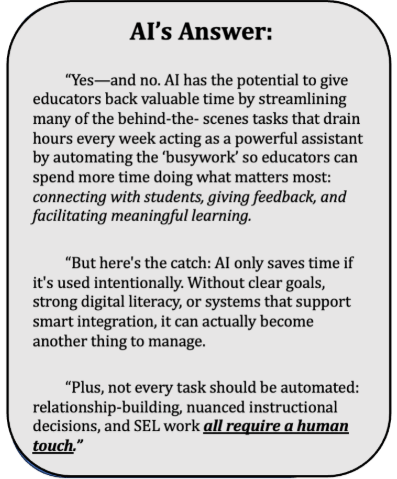
Out of curiosity, we asked our AI chatbot the following question: “Can AI actually provide educators with the gift of time by reducing the hours spent on content researching, lesson planning, data collecting, and countless ‘busywork’ tasks?”
Wise words generated by none other than AI-itself!
Final Reflections
Teachers foster strong connections with students, creating a positive and supportive learning environment that artificial intelligence cannot do. Although AI can analyze sentiment, it cannot feel. Feelings are the language of the soul. They are at the heart of teaching. We prioritize making a human connection with every child and their family. We create a community which inspires a love of learning and cultivates a sense of curiosity in students.
Educators excel with the nuances of classroom dynamics, diverse learning styles, and cultural contexts – in a way that provides intentional and effective instruction. We are truly skilled at assessing the critical thinking and reasoning skills of learners and are proficient in guiding students in complex problem-solving. We are essential in teaching ethical principles, values, and social responsibility to our youth. These key areas of emotional intelligence and social emotional learning competencies are what make us human. They highlight the unparalleled quality of human connection.
One of our most important jobs as educators is to prepare our students of all abilities for the real-world. Today’s workplaces are seeking employees who have well-developed emotional intelligence skills and are investing millions annually to strengthen the EI of their leaders and employees.
August 8, 2025
Imagine all the time, efforts, and money that would be saved if we spent quality time during the school day intentionally and explicitly teaching emotional intelligence and social emotional learning skills, within each of the CASEL competency areas, using a “human touch” to better prepare our learners for employment. Good teachers have strong knowledge of their students as individuals, how they think and think about themselves as learners, as well as of their students’ culture and community. They not only understand the subject matter they teach; they understand it in ways that are particular to their work in a classroom.
Closing Heart-Tug Story
A moment of humanity in the classroom is illustrated in the following closing story. At the end of a science lesson in a fourth-grade classroom that I, Phyl Macomber, was modeling and teaching, a student by the name of Aiden came up to me and wanted to ask me “an important question.”
Aiden inquired: “What do you think is the most important thing to learn in school, Miss Phyl? The. Most. Important.”
I replied within a second, not needing to think about it, and shared, “To be a good human, Aiden. That is the most important thing to learn.”
Aiden exclaimed with much excitement, “Well, I learn that every day from my teachers!” Artificial intelligence can NEVER replace this essential human element of teaching. Although it could be a resource to us to save us time by providing endless information and curriculum content, it has no heart. And this is the soul of teaching: HEART. Because connecting with our humanity is what it is all about.
References:
CASEL. (n.d.). What is SEL?. Collaborative for Academic, Social, and Emotional Learning. Goleman, D. (1995). Emotional Intelligence: Why It Can Matter More Than IQ. Bantam Books.
Macomber, P. (2021). Every Child Can Learn: Your Roadmap to Inclusive Education, Grace & Hope, LLC.
At the Heart of Making a Difference
We all have many commemorative moments in our lives.
Commemorative moments are occasions that mark a life transition, milestones and important events, such as your graduation day or the day you start a new job and embark on a new career. These are certainly memorable times in life. In my own professional life, one of my commemorative moments was the day I began my clinical fellowship at Johns Hopkins Hospital’s Kennedy Krieger Institute.
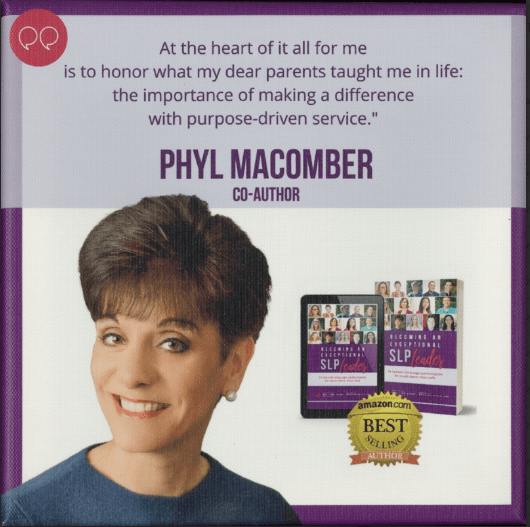
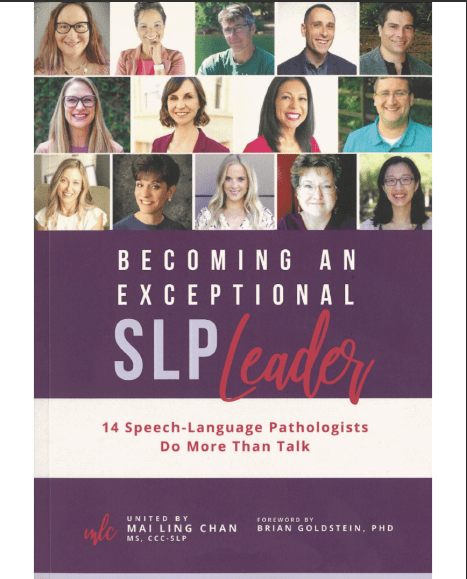
Becoming an Exceptional SLP Leader
Back then, in 1988, when it was named Kennedy Institute for Handicapped Children, I gazed up at the famous Johns Hopkins dome for the first time and was awestruck by the idea of working under the very roof where new syndromes and medical treatments were being discovered on a regular basis. From training pediatric residents to serving families who traveled internationally for answers to their children’s challenges, beginning my career in zip code 21287 on North Broadway in Baltimore, Md., was most definitely a commemorative moment in my life.
There are other types of moments, however, that I would like to chat with you about: They are called “defining” moments. A defining moment is a time when life presents you with the opportunity to make a pivotal decision. It is when you experience something that fundamentally changes you. These types of moments enable you to hone in on your greatest talents so you can make your greatest contributions. And, trust me, you will not have any trouble identifying a defining moment when it happens to you because it will empower you to take action and create a positive turning point in your life, from which you will draw endless motivation and inspiration.
Defining moments help you uncover your passion and figure out what matters to you. They help put you on a purposeful path so you can make a difference to help others.
I am 60 years old, and have served in the field of education since 1988. Many defining moments have put me on courses I never could have imagined, both personally and professionally. These defining moments have helped me figure out my true passion, which is setting up inclusive.
Phyl Macomber systems of learning so every child can learn, reach their true potential, and make meaningful contributions when learning new information and sharing what they know in their classroom community.
I firmly believe that a child does not “earn” their way into the general education classroom. It is that child’s fundamental right to be there. It is a child’s right to be a contributing member of their classroom community. It is a child’s right to be a contributing member of their school community. It is also a child’s right for their contributions to have purpose and personal significance.
I learned this firsthand as a child from my Aunt Nellie and Uncle Sammy, parents of my cousin Pam, who has an intellectual disability. By example, the two of them defined inclusion for me as a child in the early 1960s. Aunt Nellie taught me that inclusion centered on contributions; being given the opportunity to make a contribution and one that was meaningful.
For example, every Columbus Day weekend, my paternal grandfather Pop-Pop, made wine, just like he did back in Italy before he took the boat to Ellis Island. All of us cousins stomped on the grapes and used the wine press. Pam was right there with us, with everyone turning varying shades of purple! Then, during cousins’ birthday parties, we all loved jumping on the bed listening to the Monkeys-Pam often leading the charge. It was not “us” and “her” . . . Pam was a part of “we.”
As the author of T.H.E. P.A.C.T., a research-based teaching framework, and the CEO of Make A Difference Inc., I have taken my knowledge in the field of speech-language
Becoming an Exceptional SLP Leader pathology, along with my co-teaching experiences with teachers, and provided a solution to a series of problems with which I see educators continually struggle.
Teaching staff have days filled with multiple things to do and simply not enough time to do them. In addition, educators are faced with attempting to cover an incredible amount of information in an unrealistic and often impossible amount of time. Although we have individualized education plans in place “on paper” for our students receiving specialized instruction, teams continue to struggle with delivering purposeful instruction and meaningful inclusion from preschool to high school.
As opposed to feeling overwhelmed, it was important to me that educators could feel good about their daily contributions and reach students of all abilities. I knew that the answer was to systemize instruction in a delivery model that could be used by all teaching staff: classroom teachers, special educators, therapists, and consultants, therefore bridging the gap between special education and general education. This teaching framework helps staff focus, organize, and streamline their time so they can maximize their impact and use their time wisely. In addition, it does not have an expiration date, meaning it can be used from preschool through graduation.
In 2009, if you were to ask me if I would ever embark on such a journey as I am on now to make an impact in education, I would have smiled at you and thought you were bonkers! I did, however, have a defining moment occur in Orlando, Fla. that put me on this very path in the winter of 2009.
Phyl Macomber I was presenting educational sessions with a colleague at the Assistive Technology Industry Association (ATIA) national conference in January of that year. During the conference, Meg Turek, the managing editor of the Closing The Gap Solutions publication, approached me about writing an article for their educational publication.
I looked at Meg and said, “You want me to write an article? What would I possibly write about, Meg?”
She looked at me affectionately and replied, “Phyl, I want you to write about something you are passionate about and something that matters to you. I want you to share your voice.”
And so it began.
On the plane ride back to New England, I examined what truly mattered to me in education. I was very passionate about simplifying learning, which, in turn, would simplify teaching. This defining moment birthed the publication of a 4-step, color- coded teaching framework that I created, called T.H.E. P.A.C.T., which is an acronym that stands for Technology Helps Easy and Practical Accessible Curriculum Teaching. It is a “common sense” approach for teaching students from gifted to special needs-and every student in between. T.H.E. P.A.C.T. provides a practical blueprint for Universal Design for Learning (UDL) instruction in any setting.
My article focused on adapting curriculum and making curriculum content accessible for all students with varying disabilities in the classroom setting. My speech-language background served as my compass for creating this framework. Over the years, one of my core objectives was to encourage educators to partner with the language specialists in their buildings; such a partnership, I believed, was crucial to Becoming an Exceptional SLP Leader the academic success of all students because “curriculum is language.”
After the article appeared in 2009, I published my first book, recorded and produced educational resources, launched national training tours for seminars on my framework, and presented six educational sessions on T.H.E. P.A.C.T. at various national conferences.
My project started with a simple vision and heartfelt hope that it would make an impact. Over time, I saw those efforts grow and become effective in different parts of the world- across North America in the United States and Canada, in various countries in Africa, and in parts of Australia, Italy, England, and Saudi Arabia.
At the heart of it all for me is to honor what my dear parents taught me in life: the importance of making a difference with purpose-driven service.
Believe me when I say to you, though, that the scale of this project was way out of my comfort zone.
The 2013-2014 school year was an academic year of tremendous growth for T.H.E. P.A.C.T. I consulted with and trained special educators, classroom teachers, therapists, and specialists on how best to instruct their students receiving special education services in the general education classroom. Lines of communication opened up between school staff, administrators, and of equal significance, the parents. I was thrilled when classroom teachers found the framework’s strategies highly effective for not only their students receiving specialized instruction, but also successful with their entire class.
Phyl Macomber
This was another defining moment for me, and it was one of immense gratitude related to fostering inclusive practices in education. Yet, it was also a moment of feeling extremely overwhelmed regarding the road ahead of me. I felt I was being pulled in so many different directions. Principals were contacting me to conduct school-wide initiatives. I served on numerous strategic planning committees with directors of curriculum. I spoke with school boards, presented at numerous national conferences a year, and began a research study in nineteen locations across the United States and Canada. I also became an app developer on a moment’s notice.
My days were filled with meetings with teacher after teacher-some wanting to learn and others just showing up because they were told they “had to do it” by their administrator. Some days, I felt as if I was in my favorite movie, The Wizard of Oz, running from the flying monkeys and not seeing a clear path to the Emerald City. I had many restless nights and countless mornings when I was at my desk at 4:00 a.m. I had so many spinning plates, and I was just waiting for them to all come crashing down.
And they did. It was the fall of 2013, Wednesday, October 30, to be precise. I remember it like it was yesterday. It was my husband Rob’s birthday, and he came home to find me sitting in my grandfather’s barber chair in our living room in Vermont on a chilly evening. The fireplace was blazing, and I was drinking a cup of tea, my favorite, Taylors of Harrogate Yorkshire Gold with lemon. I was sobbing.
Rob immediately came over to comfort me and frantically asked me what had happened. My father’s health had recently Becoming an Exceptional SLP Leader started to decline, so Rob thought my emotional state was related to news about my dad.
I looked up at my husband with tears streaming down my cheeks and said, “I have lost my ‘WHY’ . . . and the joy in my work, Partner.” I burst into tears again. Uncontrollably. “Rob, I am not sure that I can get it back. That is what I am most worried about.”
Rob looked at me lovingly and kissed me on the forehead. He walked into my study and came back into the living room holding a copy of my first published article on T.H.E. P.A.C.T. from 2009, the one Meg Turek had asked me to write. He said, “Read this, Little Girl. You haven’t lost your WHY. You just need to be reminded of it.”
I read through the article, page after page, about “why” I created T.H.E. P.A.C.T. and why it was important to help children achieve their true potential. This was THE defining moment in my life, the one that clarified the work I was meant to do in the world and the contributions that were mine to offer.
The two-hour conversation with Rob on his birthday that year fundamentally changed me. I was reminded of what I knew about myself all along: I am an advocate for children with disabilities. I will remain tireless in my efforts to empower educators with meaningful inclusionary practices. I also know that I am successful doing a handful of things and doing them well. In fact, this is a foundational principle of T.H.E. P.A.C.T. framework that I authored. It was a pivotal point for me, which resulted in me not saying “yes” to everything moving forward because I felt that I needed to serve to the point of exhaustion.
I started to make more responsible decisions… those that gave me joy and made me 100% passionate about pursuing. I Phyl Macomber
trusted my gut when approached with an idea or a request for service. I got rid of things that drained my energy. I also made time for myself to grow, to learn, and to develop professional skills in other areas I never would have thought of before, such as formal training in speaking to the media or specific business principles that could help catapult my project.
Now, as a result of that awareness and setting healthy boundaries, I only mentor and coach people who want to learn and want to better serve in education and the business world. I focus on “My Vital Three,” the short list of top priorities, for a specific time period and get them across the finish line. I am working “smarter, not harder” by archiving recorded seminars so people can learn on their own time and on their own schedule. I also redefined the focus of my philanthropic contributions, which gives me a great deal of gratification.
I dabble in other aspects of my project that give me joy: writing my new book series, being a regular guest on radio programs and talk shows to have purposeful conversations about education, and donating time to international organizations, such as serving on the Board of Directors for the Leave No Girl Behind School of Leadership, based in South Africa. These are things that really matter to me.
My parents always taught me that no contribution was too little and that every effort to help someone counted in life. October 30, 2013 was a defining moment in my life when I was at my low . . . when I called everything into question. It was a game-changer for me to turn it around and be successful at making a better difference in my purpose-driven service.
Becoming an Exceptional SLP Leader I now write to you with tears in my eyes, because one year later, on October 30, 2014, on my husband’s birthday, I buried my greatest teacher in life-my Daddy. As I reflect on the serendipity of this, I realize there is much truth to the saying, “You do not know how strong you are until you have to be strong.”
I have had, and continue to have, many defining moments and real-life struggles throughout the growth of my educational project. These defining moments have served as sharpening stones for me, both as a professional and as a human being.
As I look to the future, I embrace each challenge with eagerness and enthusiasm. I never lose sight of why I do what I do. My moral compass always points to my belief that every child can learn and that I can be a change agent in education.
Recommendations
As a result of all of my experiences on my Yellow Brick Road of Life, I share these personal recommendations with you to serve as “Your Vital Three” when making a difference:
1. Indict the status quo. You can make a better difference in the lives of the people you serve by not being afraid of indicting the status quo. You need to have the courage to challenge the existing state of affairs when the current model, or parts of the current model, are not working. You do this by calling into question that which is broken, flawed to begin with, or simply flat-out wrong.
2. Examine your belief system and stay true to your passion. Use your belief system as a moral compass each day that you serve. It is all about the contribution, paying it forward, making an impact, and helping Phyl Macomber others. Never lose the fire in your belly for purpose- driven service.
3. Know your why. As a part of this process, answer the question, “What is your WHY?” Because if you know your “WHY”-truly know it and believe in it-you will get others to believe in it, too.
My Wish for You
My heartfelt wish for you is to believe that as long as you want to make a difference, you will find your own unique way to do so. My hope for you is that you will adopt the practice of self-reflection to grow and change as a person and as a professional.
We have the power to change anything. I wish to empower you to take steps to shape and shift belief systems through your own creative ideas of how you can help others.
Remember…
“No matter who you are,
No matter what you do…
YOU have the power to change anything.”
– Phyl Macomber
My Community
Listen to my interview on the Xceptional Leaders Podcast with Mai Ling Chan:
REFERENCES: Macomber, P. (2015). Bridging the Gap Between General Ed and Special Ed. Session presented at the SXSWedu Conference, Austin, TX. Macomber, P. and Bardole, Y. (2015). Your UDL
Blueprint: WHAT, WHY, & HOW of Evidence Based Instruction. Session presented in the Research Strand at the Assistive Technology Industry Association Conference, Orlando, FL. Macomber, P. (2014). Real-Life Success Bridging the Gap Between General Education and Special Education: The ImPACT of Universal Design for Learning. Published in the Closing the Gap Journal, June-July Issue. Macomber, P. and Emerson, J. (2014). Jam-PACT Ideas for the What, Why, & How of Research Based Instruction for Students with Autism and Developmental Disabilities. Session presented at the Closing the Gap Conference, Minneapolis, MN. Macomber, P. and Woods, C. (2014). Real-Life Success Bridging the Gap Between General Education and Special Education: The Impact of Universal Design for Learning. Session presented at the Closing the Gap Conference, Minneapolis, MN.
Macomber, P. and Quinn, F. (2013). App-timize Your Core Curriculum Instruction and Move Beyond “Here an App, There an App, Everywhere an App, App!” Session presented at the Closing the Gap Conference, Minneapolis, MN. Macomber, P. and Court, L. (2013). Systematic Structured Teaching to Support Students with Complex Needs in Inclusive Settings. Session and Paper presented at the Council for Exceptional Children Conference, San Antonio, TX.
Macomber, P. (2012). Adapting Academics, Life Skills, & Social Language Curriculum Using Systematic Structured Teaching. Session and Paper presented at the Council for Exceptional Children Conference, Denver, CO. Macomber, P. and Hall, N. (2012). A 4-Step Framework for Teaching Social Language.
Session and Paper presented at the American Speech-Language Hearing Association Conference, San Diego, CA. Macomber, P. (2010). The Power of T.H.E. P.A.C.T: The Solution to Adapting the Curriculum:
Book
West Windsor, VT: Make A Difference, Inc. Macomber, P. (2010). A Roadmap to Adapting
Curriculum: The Power of T.H.E. P.A.C.T. Two Block Session presented at the Closing the Gap Conference, Minneapolis, MN. Macomber, P. (2009). T.H.E. P.A.C.T. – Technology Helps Easy & Practical Adapted Curriculum Teaching. Published in the Closing the Gap Journal, June-July Issue. For more information on T.H.E. P.A.C.T., please go to: TheCureForTheCommonCore.com
Real-Life Success
Bridging the Gap Between General Education and Special Education:
The ImPACT of Universal Design for Learning
As the author of the research-based teaching framework called T.H.E. P.A.C.T., I collaborate with and train numerous teaching staff and related services across the United States and in Canada. I have supported countless teachers – both in general education and special education – in their daily work and also in our research studies across North America. And, unfortunately, I can say that, since completing a fellowship at Johns Hopkins Hospital in 1988, many of the same problems continue to exist in education, regardless of the year on the calendar or the postal code of the location.
AGE-OLD ISSUES ANDA PERSISTENT MYTH IN EDUCATION
Time and time again, staff members, in both general education and special education, attempt to cover an
incredible amount of information in an unrealistic, often impossible, amount of time. This instruction is typically delivered in days filled with multiple things to do and simply not enough time in which to do them.
Staff rarely get time to collaborate to be on the same page. Because of these time constraints, they are frequently forced to take a reactive approach to instruction and differentiation, as opposed to a proactive one, often not knowing what the other person is doing. I know this because I spend a great deal of time in schools, supporting teaching staff, in days where I typically have less than 180 seconds to go to the bathroom each day! Sound familiar?
The longstanding myth in education is that learners receiving specialized services need much “different” teaching strategies than those that can be used in the classroom in order to succeed in their least restrictive environment or general education setting. The TRUTH of the matter is that the successful, research-based strategies
used with our learners in special education should be used with students of all abilities, in any general education classroom.
It is also important to remember that good content does not always equal sound instruction. A vast amount of curriculum content is not delivered in “bite-sized” chunks in the classroom, nor in a language-based sequence, that best foster understanding and demonstration of knowledge that our students need, regardless of ability, in order to meet the standards. Although educational plans are in place “on paper” for our students with disabilities, teams continue to struggle with meaningful inclusion of these learners, ranging from kindergarten to high school.
The chances are that, during the brief time you have been reading this article, you have already thought of some of your very own classroom teachers and educational team members, serving learners with varying abilities, who are experiencing these same problems. In fact, you probably are too!
PHYL T. MACOMBE R, M.S. ATP Author and Curriculum Strategist. President of Make A Difference, Inc. Since completing a fellowship at Johns Hopkins Hospital’s Kennedy-Krieger Institute in 1988, Phyl T. Macomber has become an award-winning national speaker, author, developer, curriculum strategist, AT specialist and trainer. Phyl is a retired speech-language pathologist who, now in a leadership role, spends a signi”cant amount of time working with a diverse population of learners – both in special education and regular education – directly mentoring and coaching school-based sta! in classrooms, related service settings and learning centers. Phyl’s curriculum framework, called T.H.E. P.A.C.T.™ – Technology Helps Easy & Practical Adapted Curriculum Teaching™ – is being successfully used in regular education, special education and related service settings throughout the U.S. and in Canada. Email: Phyl@AboutTHEPACT.com; Telephone: (802) 484-3537; Website: www.AboutTHEPACT.com
THE CRUCIAL MISSING PIECE The fundamental fact is that multisensory learning techniques reach all students in any setting. This is the crucial missing piece that exists between general education and special education. Multisensory teaching needs to be used consistently in both settings! Integrating these multisensory strategies into a system of instruction, to guarantee the principles of Universal Design for Learning in the general education classroom, is essential when making it both “doable” and “sustainable” in a jam-packed school day. At any grade level, sequencing instruction into “connect-the-dot” lessons is essential for any learner’s brain to reduce cognitive load in the learning process. Using a system of instruction in the classroom assists with making this become a reality. In addition, it is important to explicitly teach all language components in each lesson, so that we do not cut corners, in what I refer to as “drive-by” lessons, and assume knowledge of language that learners do not possess. Teaching staff sometimes need to be reminded of this, as I often see that they know their content so well, that many times they forget what it is like to “not know it.” For example, Terry Griffin, Assistant Professor at Westfield State University in Westfield, Massachusetts, describes, “Through T.H.E. P.A.C.T. framework that Phyl has authored, this four-module, research-based approach to learning does a wonderful job of making the ‘too often invisible’ language of all curriculum ‘VISIBLE’ to learners of any ability.” This professor goes on to explain that, through the framework’s color-coded modules of “Learn About, Read About, Write About and Talk About,” students of all abilities become proficient in the key areas of language in the classroom. See image 1. THE ESSENTIAL QUESTION What type of impact is this really having in the trenches when bridging the gap between general education and special education? Bridging the Gap: Real-Life Success Stories
To help answer this question, we will examine the largest, multi-district School Administrative Unit (SAU) in New Hampshire:
SAU 29. So, let me now introduce you to the real-life success in Joanne Sullivan’s kindergarten classroom at Benjamin Franklin El-