Professional development (PD) for teachers faces several challenges. This includes inadequate funding, lack of time, ineffective delivery methods, and poor alignment with teachers’ needs.
Many programs are poorly designed, lack practical application, and fail to address the specific challenges teachers face in their classrooms. This, in part, is due to the fact that many presenters are far removed from the classroom setting.
Countless facilitators of PD simply do not spend significant time in the places that the everyday real problems exist: THE CLASSROOM. This leads to teacher dissatisfaction, reduced motivation, and limited impact on classroom practice.
Many professional development programs are generic and fail to address the specific needs and contexts of individual teachers and schools. Meaning, they are a “one-size-fits-all” content approach. They also lack opportunities for teachers to try out new strategies in their classrooms and receive feedback; making it difficult to translate learning into practice.
Professional development opportunities should support teachers in identifying their own goals and how they plan to pursue them. When teachers work on improving their work together, they can make collective choices for their long-term professional development.
Effective professional development takes time. Schools will not achieve their goals with short-term, or “one-off” training for teachers, much like how touch-and-go lessons are not effective for students.
Instead, administrators need to set up and connect teachers’ learning with real-world classroom applications over longer periods of time. After undergoing training, teachers should apply their learnings in the classroom and evaluate how the application went.
Professional development is most effective when it includes ongoing support, coaching, and opportunities for teachers to collaborate and reflect on their practice.
Additionally, it is crucial that the administrators and teaching staff – both in general education and special education – feel that what they are learning in achievable and relevant to not only elevate their instructional practice, but also significantly improve student learning.

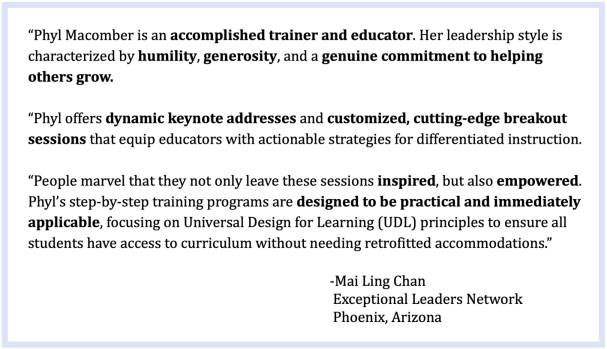
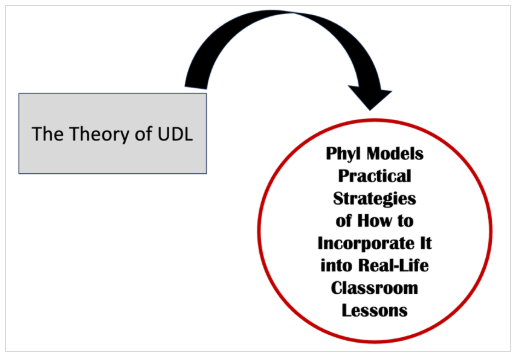
Phyl Macomber’s award-winning “Use-the-Next-Day” practical professional development model delivers research-based instructional strategies that are immediately usable across all grades levels and learning environments.
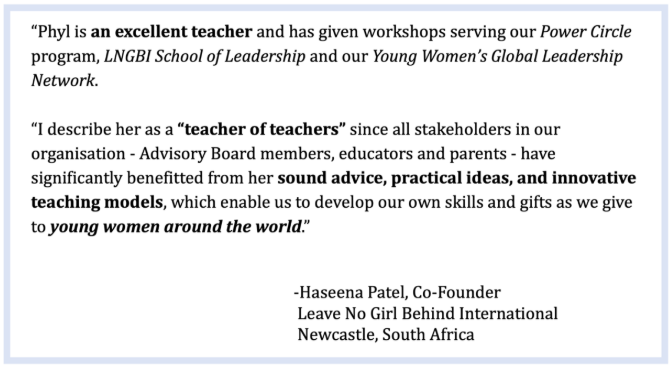
Phyl is a “master teacher of teachers” – possessing a unique balance of expertise in pedagogy related to teaching methodologies, learning theories, and curriculum development paired with showing educators how what she teaches meaningfully unfolds in everyday classroom instruction.
Simply put, Phyl does not ask teaching staff to do anything that she herself does not do.
Meaning, Phyl “walks the walk” partnering with all teaching staff – from classroom teachers to paraprofessionals, modeling easy-to-use practical strategies to reach and teach learners of all abilities.
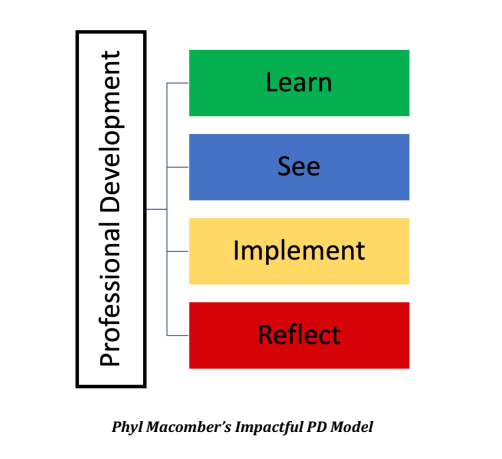
Phyl Macomber excels at understanding how adults learn and tailors her professional development in a proven “learn, see, and do” model which creates effective and engaging learning experiences.
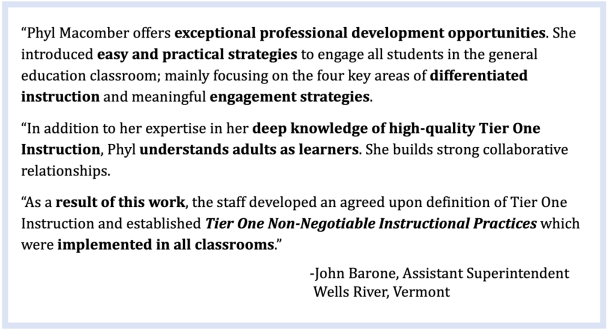
Phyl’s goal is to provide administrators and teaching staff with the tools and strategies they need to refine their instructional practices, leverage new technologies, and adapt to changing student needs.

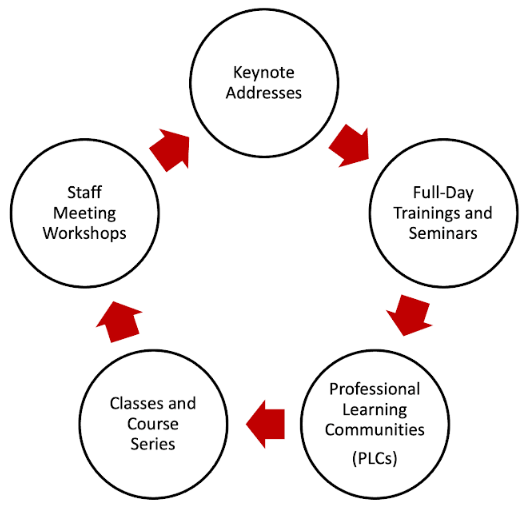
Phyl offers a variety of professional development options:
- Full-Day Trainings and Seminars
- Professional Learning Communities (PLCs)
- Classes and Course Series
- Staff Meeting Workshops
- Keynote Addresses
Each of these options may be delivered in a customized professional development package to include the “learn, see and do” model to enhance teacher effectiveness and improve student outcomes.
The teaching staff have the opportunity to see what they have learned with “real time” modeling from Phyl in a supportive environment.
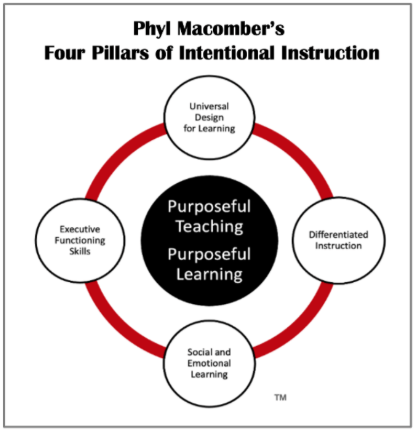
The “Use-the-Next -Day” instructional strategies that Phyl teaches foster inclusive educational practices related to:
- Learner agency and the three areas of Universal Design for Learning
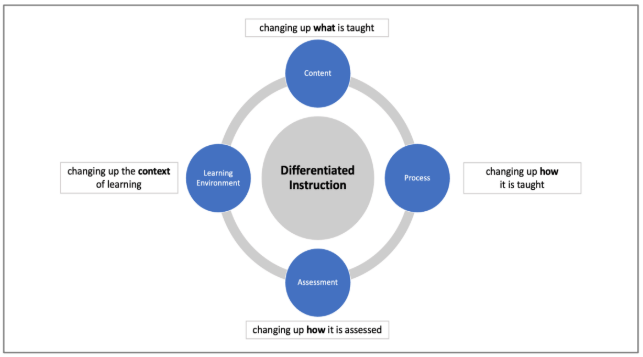
- The four distinct areas of Differentiated Instruction
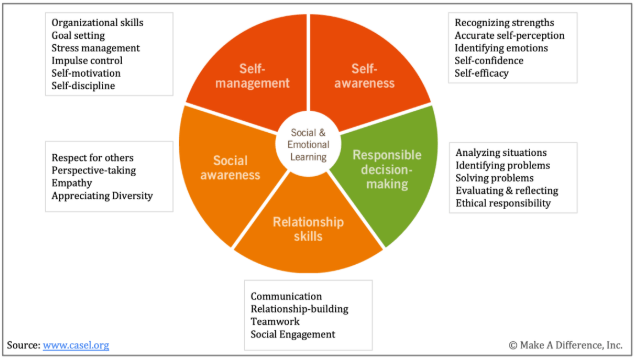
- The five competency areas, with associated skills, of Social Emotional Learning
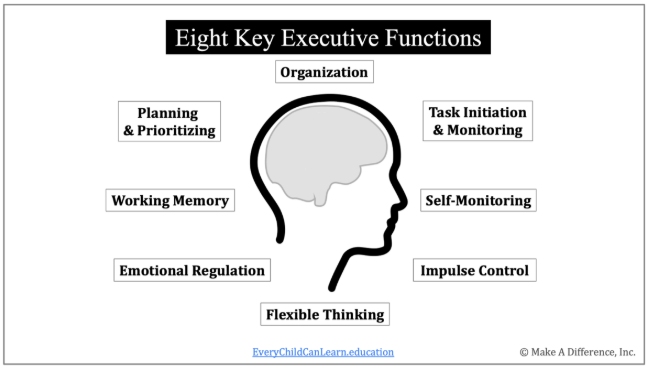
- Key Executive Functioning Skills
From large group classroom lessons to specialized instruction, Phyl shows how what the teaching staff learns could be applied at any grade level or any setting – therefore, bridging the gap between special ed and general education.
Phyl also extends this PD to instructional support staff, empowering the “in the trenches” paraprofessionals with the critical tools and strategies they need to support learners with varying abilities.
Whether a one-on-one support or a classroom aid, the instructional support staff gain valuable knowledge in understanding how the brain learns, understands, processes, and expresses language for the “Top 5 Brain-Based Skills.” This assists them with “helping not hovering” when working with the students they support.


Examples of Phyl’s professional development topics include, but are not limited to:
“The How-To Guide for Meaningful Inclusion”
“The Four Pillars of Intentional Instruction”
“The Everyday Practice of Universal Design for Learning”
“A Deep-Dive into Differentiated Instruction”
“The Social Emotional Learning Guidebook”
“Essential Executive Functioning Lessons”
“The Paraprofessional Playbook”
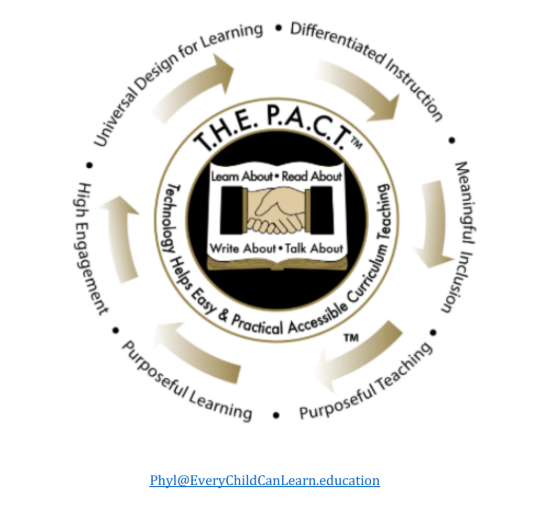
“T.H.E. P.A.C.T. Research-Based Teaching Framework”
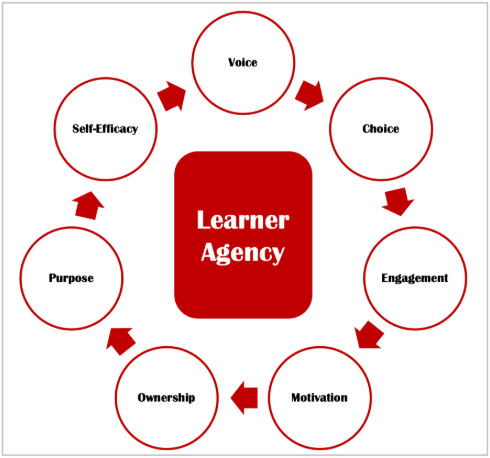
“Empowering Student Voice and Engagement”
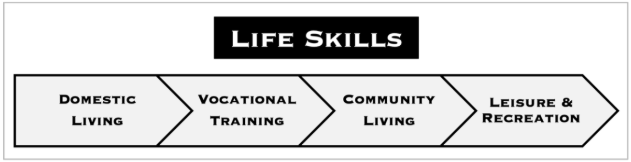
“The Four Quadrants of Life Skills”
Each of these offerings are essential to improve every day, high-quality instruction.

You can also work with Phyl Macomber to design your own customized professional development.
From full-day seminars to course and class series, you can work collaboratively work with Phyl to create your own unique offerings aligned to your improvement plans and teachers-based interests.
Turn a portion of your staff meetings into meaningful training environments and transform your PLCs into more laser-focused, goal-oriented discussion groups.

Phyl also assists administrators and staff with curriculum development; designing and adapting training materials and curriculum to meet the needs of specific teachers.
Phyl’s vast knowledge ofinstructionaldesign and adultlearningprinciples ensure that your training materials and curriculum are directly aligned with your organizational goals and learner needs.