
The Four Pillars of Intentional Instruction
Instruction that lacks intention can lead to frustrating learning experiences for both students and teachers alike. It hinders the development of deep understanding, critical thinking skills, and overall learning success for students of all abilities.
This results in learners struggling to understand the relevance of their instruction. This brings about decreased student engagement and a decline of motivation – as demonstrated by student inquires such as, “Why do we have to learn this?”
Oftentimes, when learning experiences are not “followable” to students, they rush to task completion instead of deeply engaging with the material – confusing “compliance” with “understanding.”
Intentional teaching is critical because it allows educators to deliberately plan and implement learning experiences that cater to individual children’s needs, interests, and learning styles. This approach leads to more effective learning, stronger relationships, and increased engagement for students.
Intentional instruction, however, goes way beyond posting a learning target and having a basic lesson plan in place. It involves purposefully incorporating each aspect of whole-child instruction in everyday lessons.
Each instructional lesson needs to prioritize a student’s overall well-being and development, not just their academic performance. It recognizes that a child’s physical, emotional, social, and cognitive needs are interconnected and impact their ability to learn and succeed.
Published in early 2024, Phyl Macomber’s Every Child Can Learn educational project premiered the Four Pillars of Intentional Instruction:
- Universal Design for Learning (UDL)
- Differentiated Instruction (DI)
- Social and Emotional Learning (SEL)
- Executive Functioning (EF)
The educational belief system behind the Four Pillars of Intentional Instruction is that instruction needs to center around “presence of contribution” and educating the whole child in everyday lessons. It is a deliberate and purposeful approach to teaching that considers the specific needs, interests, and abilities of learners.
In order for any learner to achieve a high level of “presence” to “contribute,” we, as educators, need to ensure that every lesson we teach incorporates at least one component or skill in each of these four essential areas: UDL, DI, SEL, and EF – including integrating practical technology solutions in the learning environments.

Using the Four Pillars of Intentional Instruction framework results in educators changing how they “think” and changing how they “plan” because it involves careful planning, delivery, and reflecting on instruction to maximize learning outcomes.
A Deliberate and Purposeful Approach to Teaching
Related to instruction, it is common knowledge that teachers have “go-to” types of activities and lessons they use regularly based on the success of student engagement and what speaks to their own style of teaching.
Phyl guides educators to begin this four-pillar process with listing these “types” of activities and lessons they use in their classroom instruction as part of improving their intentionality mindset.

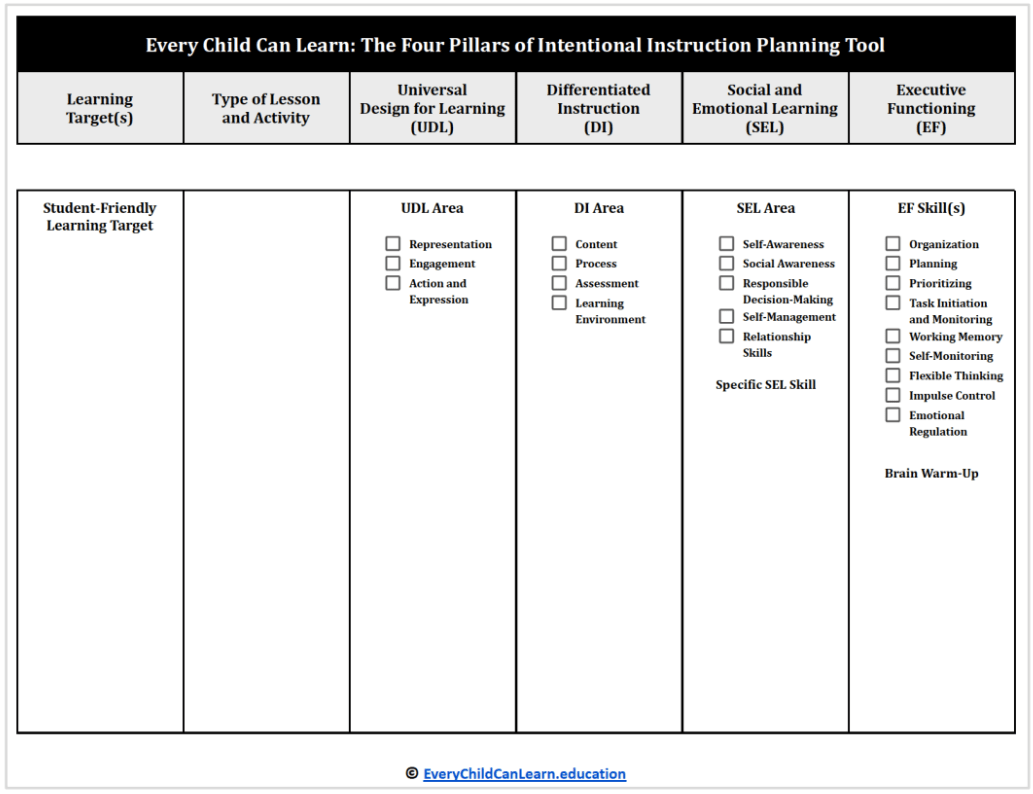
This teacher routinely incorporated a vocabulary study in her classroom lessons. In this lesson, students create their own vocabulary reference tool. Related to this “type” of lesson, she outlined student-friendly learning targets to add to her Four Pillars of Instructional Intention Planning Tool. Phyl then guided this educator in a collaborative work session on how she would incorporate each of the four pillars into this instructional lesson that she routinely taught throughout the year so they are visible to her students and to her.

Universal Design for Learning (UDL) is an educational framework that aims to create learning environments accessible to all students by providing multiple ways for them to (1) access information, (2) engage with the material, and (3) demonstrate their understanding.
This means that educators are designing instruction to accommodate diverse learner needs and minimize barriers to learning for everyone, including those with disabilities. Simply put, it emphasizes flexibility and choice within the learning process.

Phyl excels at taking the “theory of UDL” and giving educators practical ways to incorporate it into everyday lessons, specific to a particular educator’s teaching style and needs of the student population.
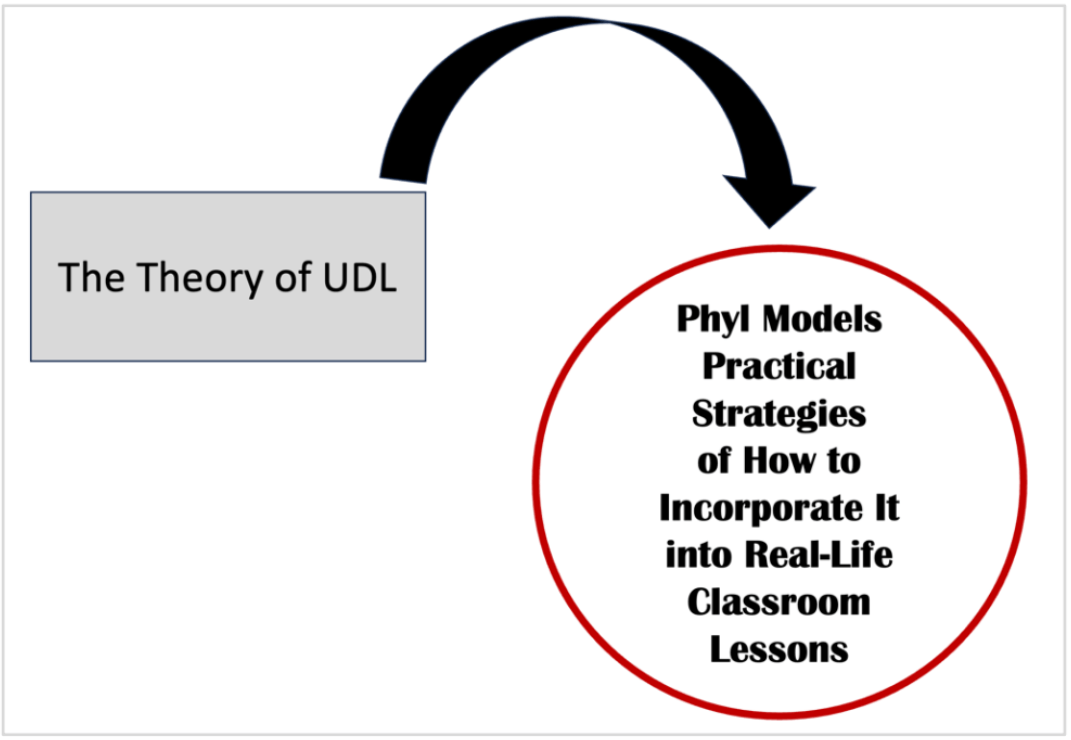
This teacher easily incorporated one aspect of UDL into her vocabulary study lesson that she routinely taught and added it to her “Four Pillar Plan” for the UDL Pillar to provide intentional instruction in this area.
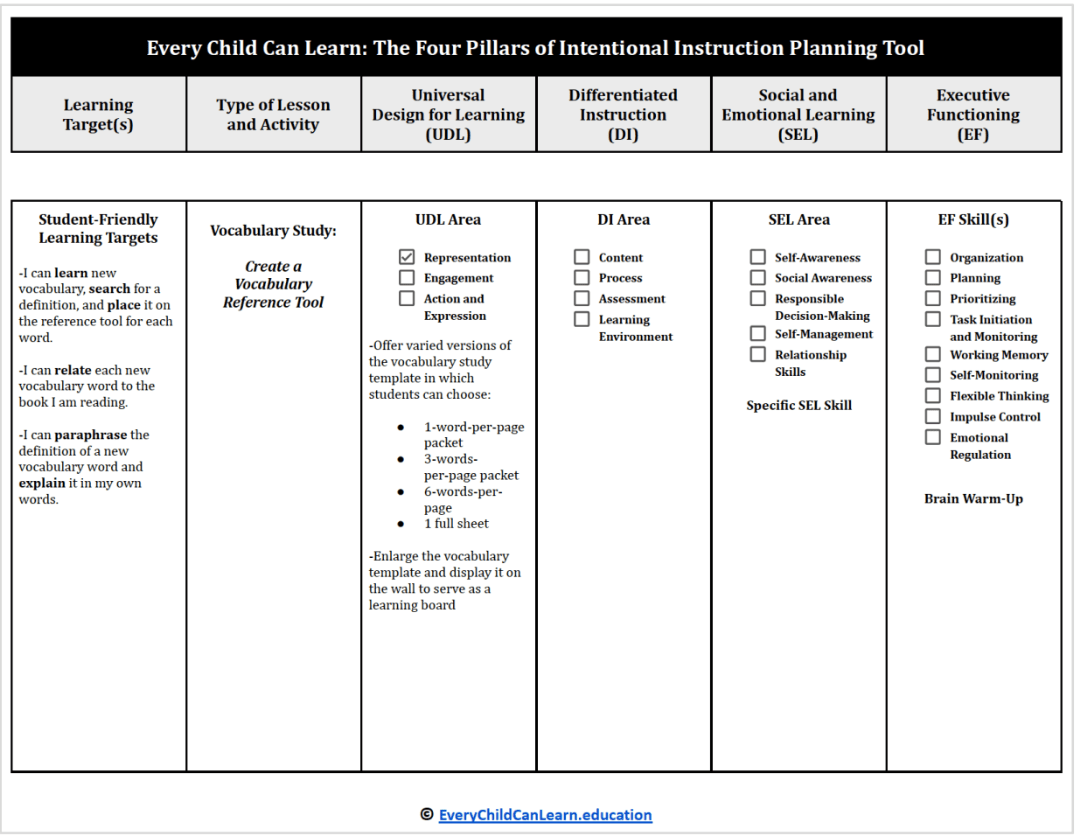
Teacher Example of Intentional Integration of UDL in the Vocabulary Study Lesson

Differentiated instruction is a teaching method where teachers adjust their instruction to meet the diverse needs of each student in the classroom – tailoring content, activities, and assessment methods to cater to individual strengths and learning styles, while still aiming for the same overall learning goal for everyone.
When differentiating instruction, educators provide different ways for students to access and demonstrate their understanding of the material.
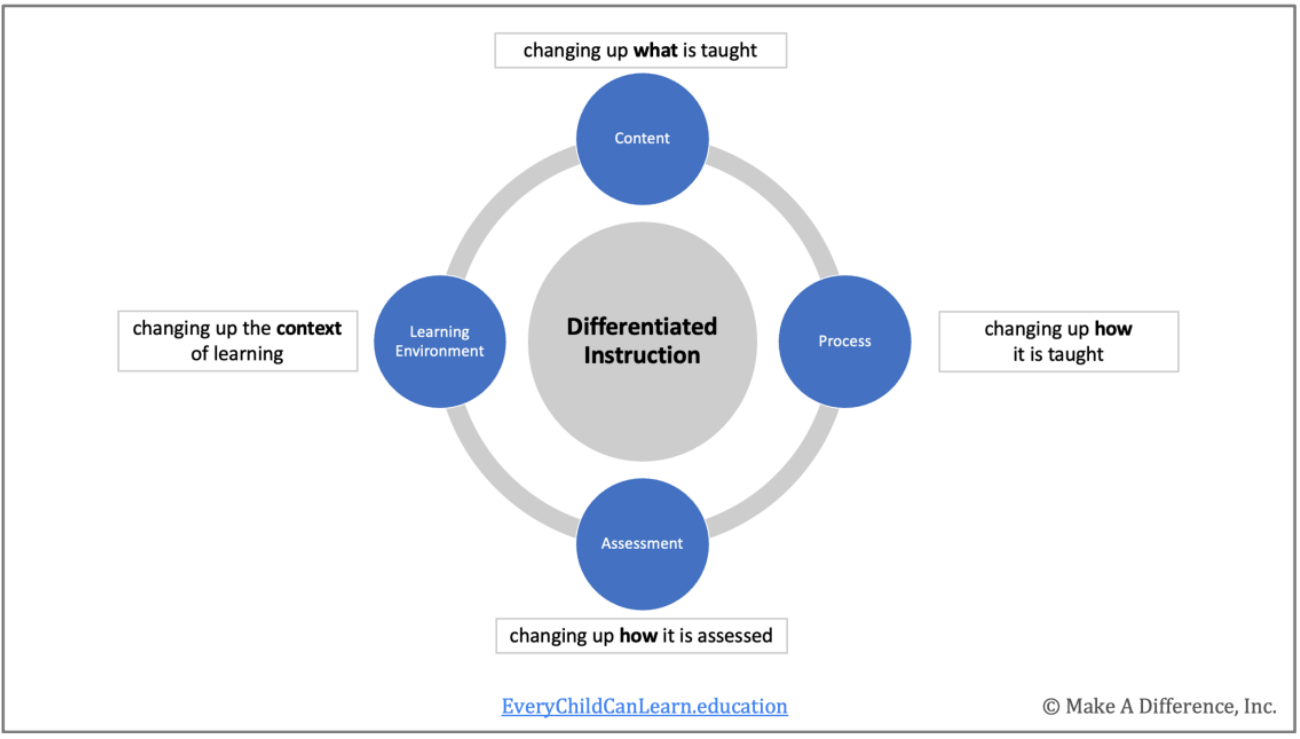
There are four main areas of how to differentiate instruction:
- Content: changing up what is taught
- Process: changing up how it is taught
- Assessment: changing up how it is assessed
- Learning Environment: changing up the context of learning
Phyl guided this teacher on how to easily incorporate one aspect of differentiated instruction into this vocabulary study lesson that she routinely taught. As a result, this educator added it to her “Four Pillar Plan” for the DI Pillar to provide intentional instruction in this area.
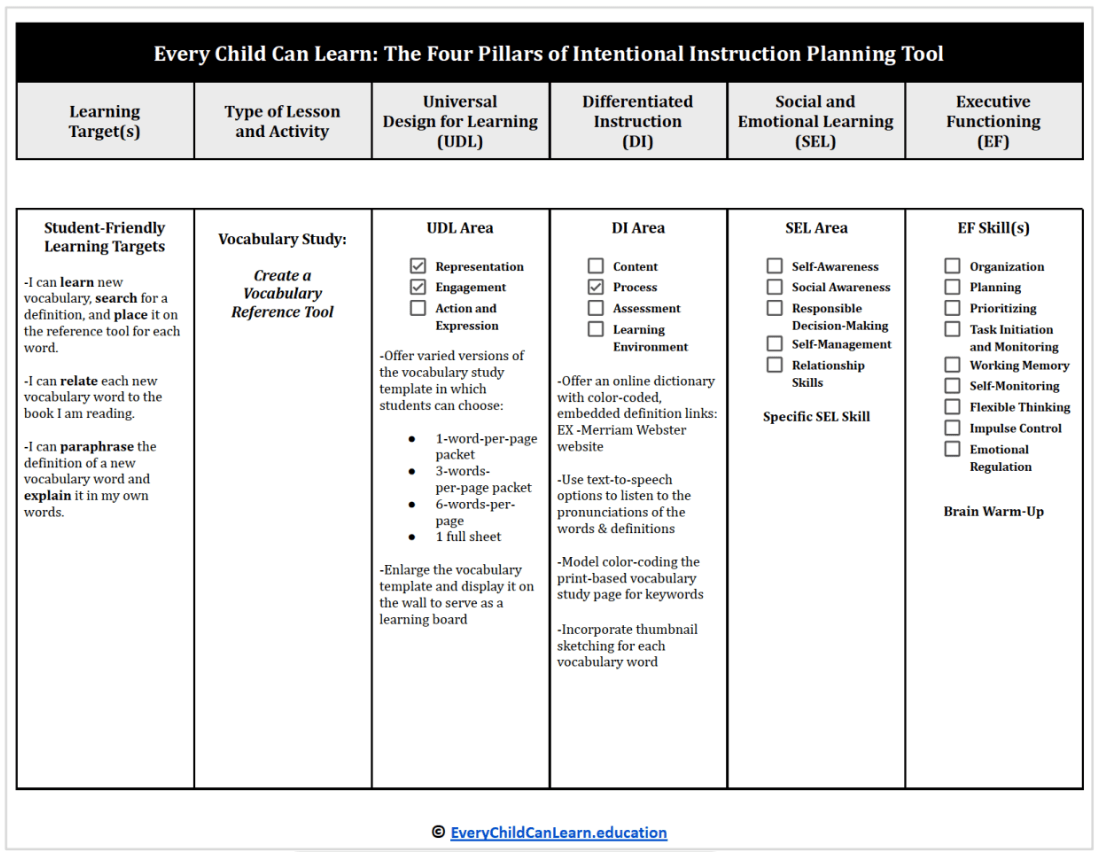
Teacher Example of International Integration of DI in the Vocabulary Study Lessons

Social and emotional learning (SEL) is an integral part of education and human development. It helps us acquire and apply the knowledge, skills, and attitudes to develop healthy identities, manage emotions, and achieve goals. SEL skills also help us make responsible and caring decisions.
There are five competency areas for social and emotional learning (Casel Framework):
- Self-Awareness
- Social Awareness
- Responsible Decision-Making
- Self-Management
- Relationship Skills
There are specific skills in each of these five competency areas that need to be explicitly taught in direct instruction.
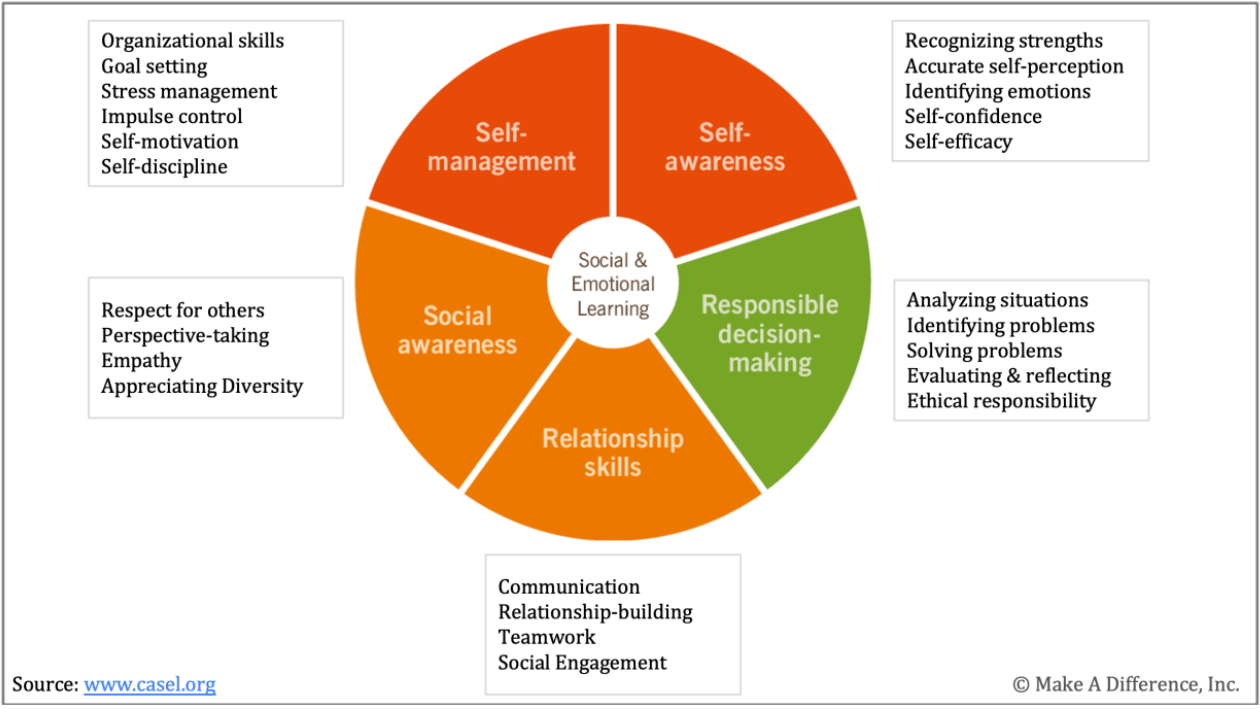
In this collaborative work session, Phyl highlighted for this teacher how to integrate one aspect of social emotional learning competency and corresponding skill into this vocabulary study lesson that she routinely taught. Then, this educator added it to her “Four Pillar Plan” for the SEL Pillar to provide intentional instruction in this area.
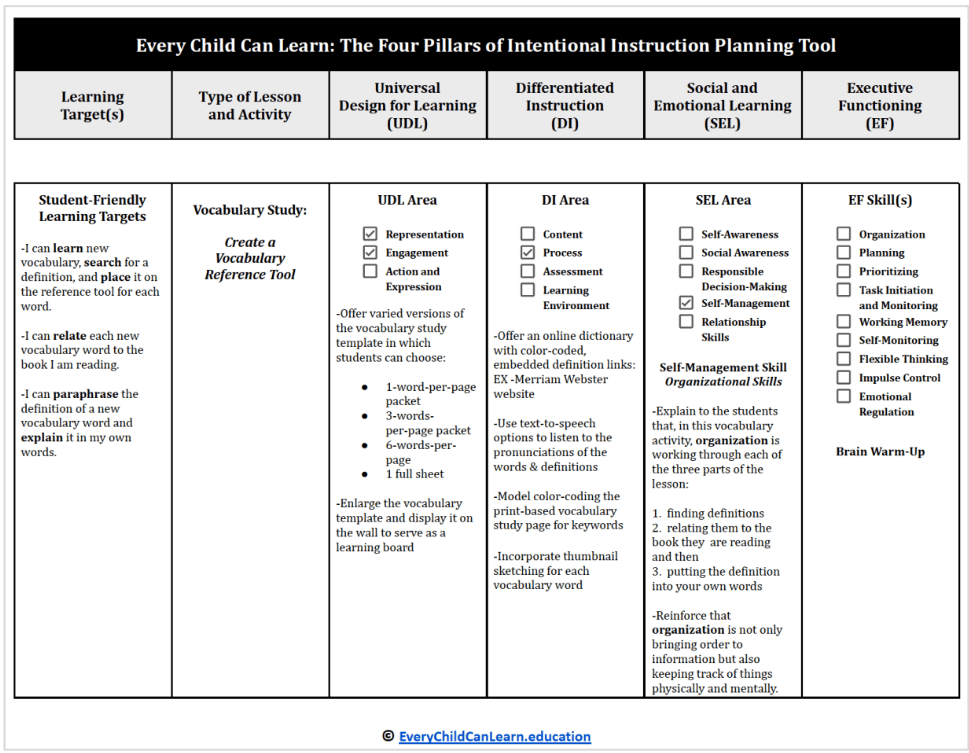
Teacher Example of International Integration of SEL in the Vocabulary Study Lesson

Executive function is the self-management system of the brain. It allows us to organize and plan, focus and shift focus, and manage emotions, along with other important tasks. Our executive functions are a set of processes that have to do with managing oneself and one’s resources in order to achieve a goal.
Executive functions can be broken down into specific cognitive components that are required in order for us to be organized, self-regulated, and adjust to things that we encounter throughout our daily lives.
The following are eight key cognitive processes that make up executive functions:
- Organization
- Planning and Prioritizing
- Working Memory
- Task Initiation and Task Monitoring
- Impulse Control
- Flexible Thinking
- Emotional Regulation
- Self-Monitoring
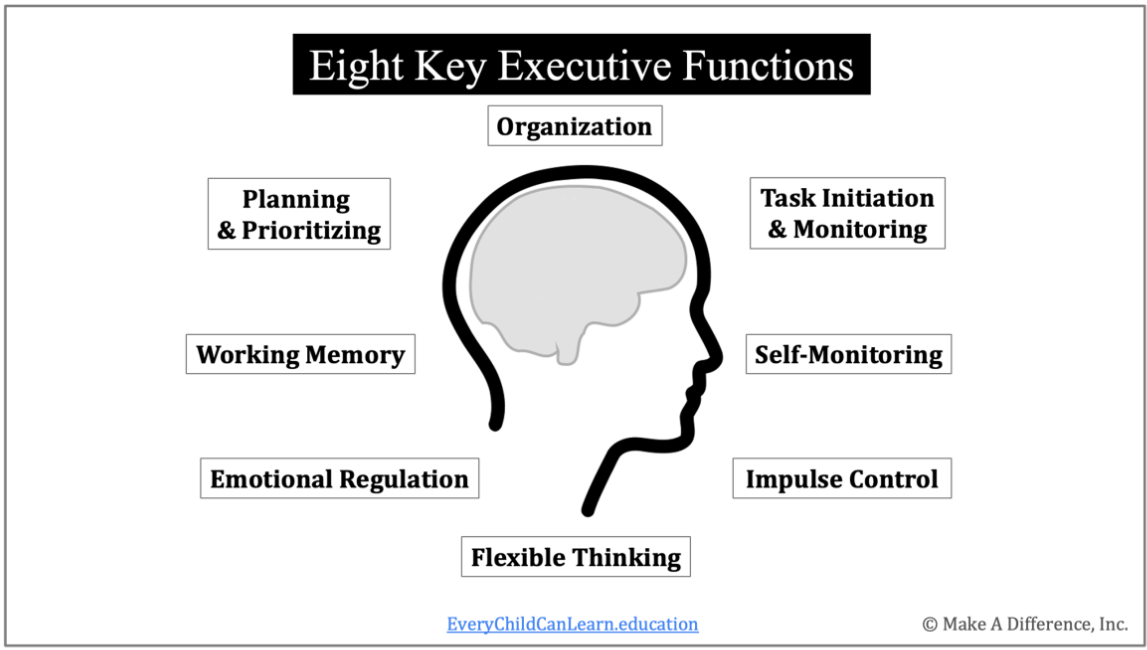
To complete the Four Pillar Plan, Phyl and this teacher discussed the importance of providing executive functioning warm-ups and how to use them at the start of any classroom lesson.
An executive functioning warm-up is a short exercise designed to engage and practice key executive functions before starting a task or activity that requires a specific cognitive effort to be successful in the lesson.
Executive functioning warm-ups essentially “prime the brain” to perform better in the activity that follows. Phyl guided this teacher in how to add an EF warm-up to this vocabulary study lesson to provide intentional instruction in this pillar area.
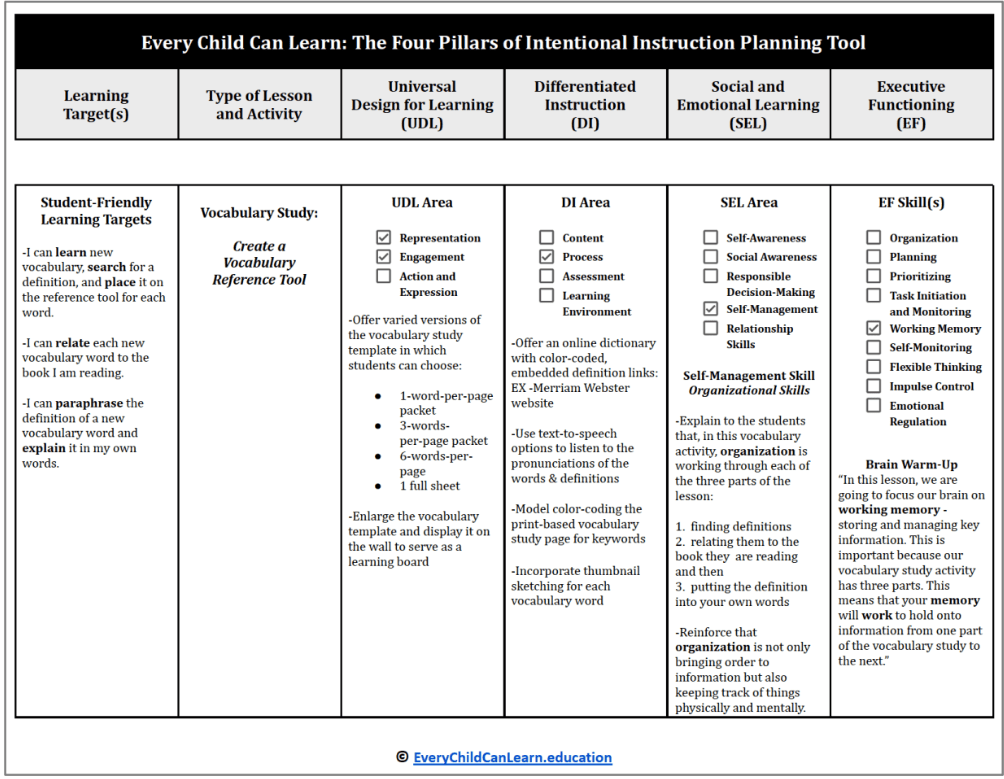
Teacher Example of International Integration of EF in the Vocabulary Study Lesson

By using the Four Pillars of Intentional Instruction approach, teachers not only created plans to share with each other in Google Drive to develop a bank of intentional teaching plans, but they shaped the lens of how they looked at delivering instruction which centered around intentionality.
This framework becomes so intuitive to teachers that they end up “thinking on their feet” of how to incorporate each of the pillars in their everyday teaching. Additionally, administrators cultivated professional learning communities (PLCs) using this practical approach to ensure inclusive education.
By elevating the intentionality of instruction, educators develop a customized “go to” instructional handbook that takes into account the individual needs, interests, and learning styles of each student. While having a plan, teachers can adjust their approach based on student engagement and learning.
The result of using the Four Pillars of Intentional Instruction framework is “purposeful teaching” and “purposeful learning.”